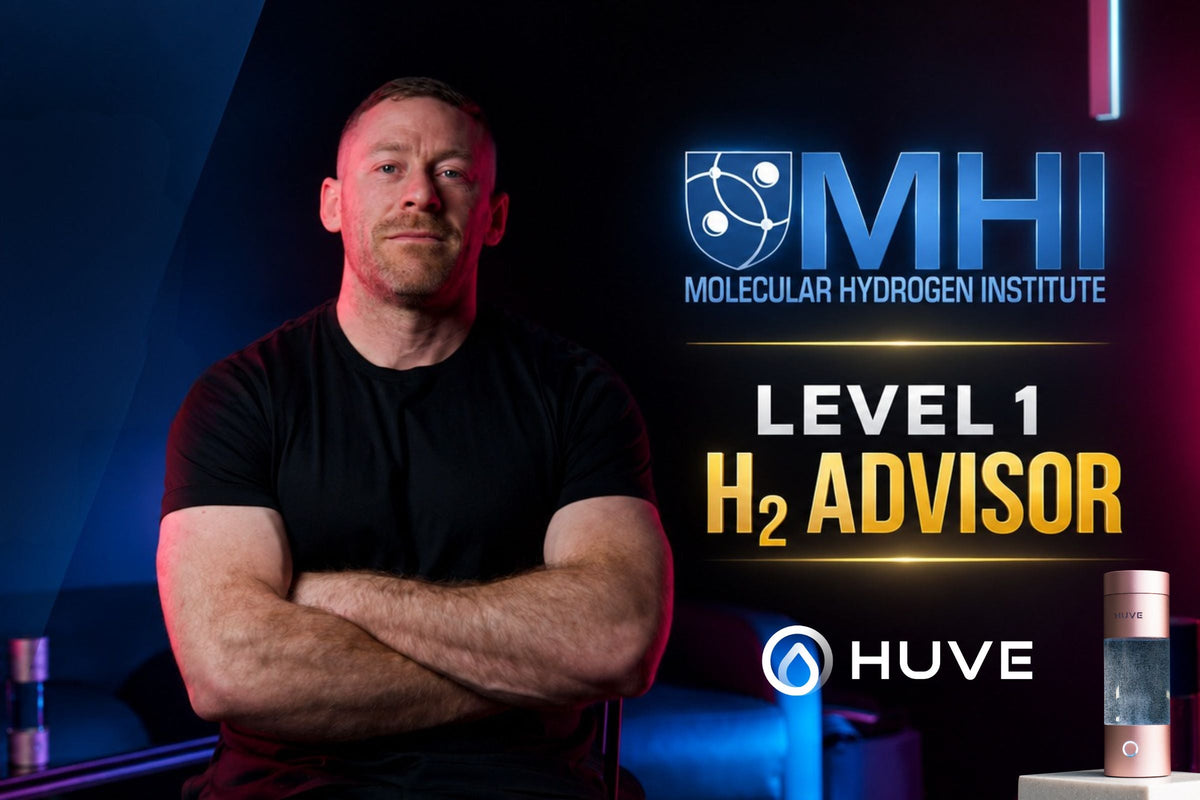
HUVE founder Josh Odgers has earned the Molecular Hydrogen Institute (MHI) Level 1 H₂ Advisor certification. It is a milestone for Josh and a reflection of the standard we want behind every HUVE product: thoughtful development, independent evidence and transparent product claims.
Quick answer: Josh holds MHI’s Level 1 H₂ Advisor credential, which recognises completion of its education programme and comprehensive exam. Separately, HUVE’s policy is to have every product independently tested by a third party before it goes on sale.

What does MHI Level 1 H₂ Advisor certification mean?
The MHI Level 1 programme takes students through six courses and a final comprehensive assessment. It covers scientific thinking, basic chemistry, the different forms of hydrogen, hydrogen water, and how to evaluate research and product claims.
A practical principle from the programme is to ask what a claim actually means, how it was measured, and whether the evidence supports the words being used. In a category where impressive numbers and sweeping promises can be easy to publish, those questions matter.
View Josh Odgers’ MHI Level 1 certificate.
HUVE is led by an MHI-certified H₂ Advisor
Our goal is to develop and deliver the highest-quality products we can. Josh’s certification adds to the scientific literacy behind our hydrogen-related decisions, from reviewing research to explaining what a product test does, and does not, show.
When we assess a product or a claim, we ask:
- What was measured, and under which conditions?
- Was the result checked by an independent third party using a suitable method?
- Does the customer-facing claim match the result without stretching it into an unsupported health promise?
Education helps us ask better questions. Independent testing supplies product-specific evidence. We believe customers deserve both.
Our policy: third-party testing before sale
Every HUVE product must be independently tested by a third party before it goes on sale. This policy applies across our range. The relevant measurements and testing methods differ by product, but the principle is the same: do not ask customers to rely on a marketing claim alone.
Our About HUVE page shares examples of the independent evidence behind HUVE Perform and HUVE Flow, including their published laboratory reports. Those reports describe tested samples, methods and conditions; they do not mean every individual unit was lab-tested or prove a particular health outcome.
HUVE Perform: designed with care, improved in V2
Attention to detail shaped the original HUVE Perform, from its portable 230 mL serving to the materials, electrolysis system and pressure management. We then refined the design for Perform V2, with improvements to electrolysis efficiency, the pressure-release valve and component precision.
Both generations combine a durable aluminium exterior with a BPA/BPS-free Tritan™ water chamber. In our view, this is the best material combination for a portable hydrogen water bottle: Tritan™ offers clarity, low weight and impact resistance, while aluminium gives the bottle a robust exterior. Glass and polycarbonate have their own strengths and trade-offs. Read our Tritan™ vs glass vs polycarbonate guide to see why we made this choice.
We publish independent laboratory evidence behind the Perform range, including reports from H₂ Analytics and H₂HUBB. In H₂HUBB's 10-minute distilled-water tests, the original Perform averaged 5.60 mg/L of dissolved H₂, or approximately 1.30 mg in its 230 mL serving. The V2 test averaged 8.82 mg/L, or approximately 2.03 mg in the same serving volume.
Those tested serving amounts are roughly 2.6 and 4 times the IHSA's voluntary product benchmark of 0.5 mg H₂ within up to 1 L of water, respectively. The comparison is about total H₂ measured in each tested serving, not concentration in mg/L.
Ready to upgrade your hydrogen water bottle? We're offering eligible customers a 40% off voucher for HUVE Perform V2. See the linked blog for how to qualify. Promotion terms apply.
What this means for our customers
Josh’s MHI certification and HUVE’s pre-sale testing policy are two distinct parts of our approach. One demonstrates his completion of a structured education programme. The other sets a product evidence requirement before we offer something for sale.
We will keep building products with care, checking the claims we make and giving customers a clearer basis for their decisions. That is what high standards mean to us in practice.
Frequently asked questions
Is Josh Odgers MHI certified?
Yes. Josh Odgers, founder of HUVE, earned MHI’s Level 1 H₂ Advisor certification. His certificate was issued on 29 September 2026.
Is HUVE or a HUVE product MHI certified?
No. The MHI Level 1 credential belongs to Josh as an individual. It is an education credential, not a certification, endorsement or recommendation of HUVE or its products by MHI. Product testing is a separate process. Read MHI’s certification information.
Are HUVE products third-party tested before sale?
Yes. HUVE’s policy requires independent third-party testing before any product goes on sale. The tests are chosen for the characteristics relevant to each product. You can explore examples and linked reports on our About HUVE page.
Does the H₂ Advisor credential prove a product’s health benefits?
No. The credential shows completion of MHI’s Level 1 education and exam. Laboratory testing can establish measured product characteristics under stated conditions. Claims about health outcomes require their own appropriate clinical evidence.
Explore the evidence behind HUVE
See the independent testing information on About HUVE, or explore our products and the details behind each one.
Wellness. Elevated.