
When comparing hydrogen water bottles, a longer electrolysis cycle can sound more powerful. If 10 minutes is good, surely 20 or 40 minutes must be two or four times better?
Independent test results show why it is not that simple.
Longer cycles can increase dissolved molecular hydrogen, but the increase is often not proportional to the extra waiting time. Once a bottle reaches higher concentrations and pressures, each additional minute may add progressively less dissolved H₂. That means a long cycle can deliver a lower average hydrogen dose per minute than a shorter, well-engineered cycle.
For anyone comparing 3, 5, 10, 20 and 40-minute hydrogen water bottle cycles, the most useful question is not:
Which bottle runs for the longest?
It is:
Which bottle delivers a meaningful, independently verified H₂ dose in a practical amount of time?
What does hydrogen water bottle cycle time actually mean?
A hydrogen water bottle uses electrolysis to generate molecular hydrogen gas and dissolve it into water. The cycle duration is simply how long the electrolytic cell operates.
Cycle time alone does not establish performance. The final dissolved hydrogen result also depends on factors including:
- Electrolytic cell output and efficiency
- PEM/SPE membrane design
- Drinking-water volume
- Internal pressure and pressure regulation
- Bottle seals and construction
- Water temperature and composition
- The amount of hydrogen retained in solution
- The testing method and time taken to measure the water
A well-designed 10-minute bottle can therefore deliver a higher concentration or total dose than another bottle running for 20 minutes or longer.
Concentration and dose are not the same thing
Hydrogen bottle marketing often focuses on concentration in parts per billion (ppb), parts per million (ppm) or milligrams per litre (mg/L). For dilute water measurements, 1 mg/L is approximately 1 ppm, or 1,000 ppb.
Concentration tells you the strength of the hydrogen water. Dose tells you how much molecular hydrogen is present in the serving you actually drink.
The calculation is:
H₂ concentration (mg/L) × water volume (L) = H₂ dose (mg)
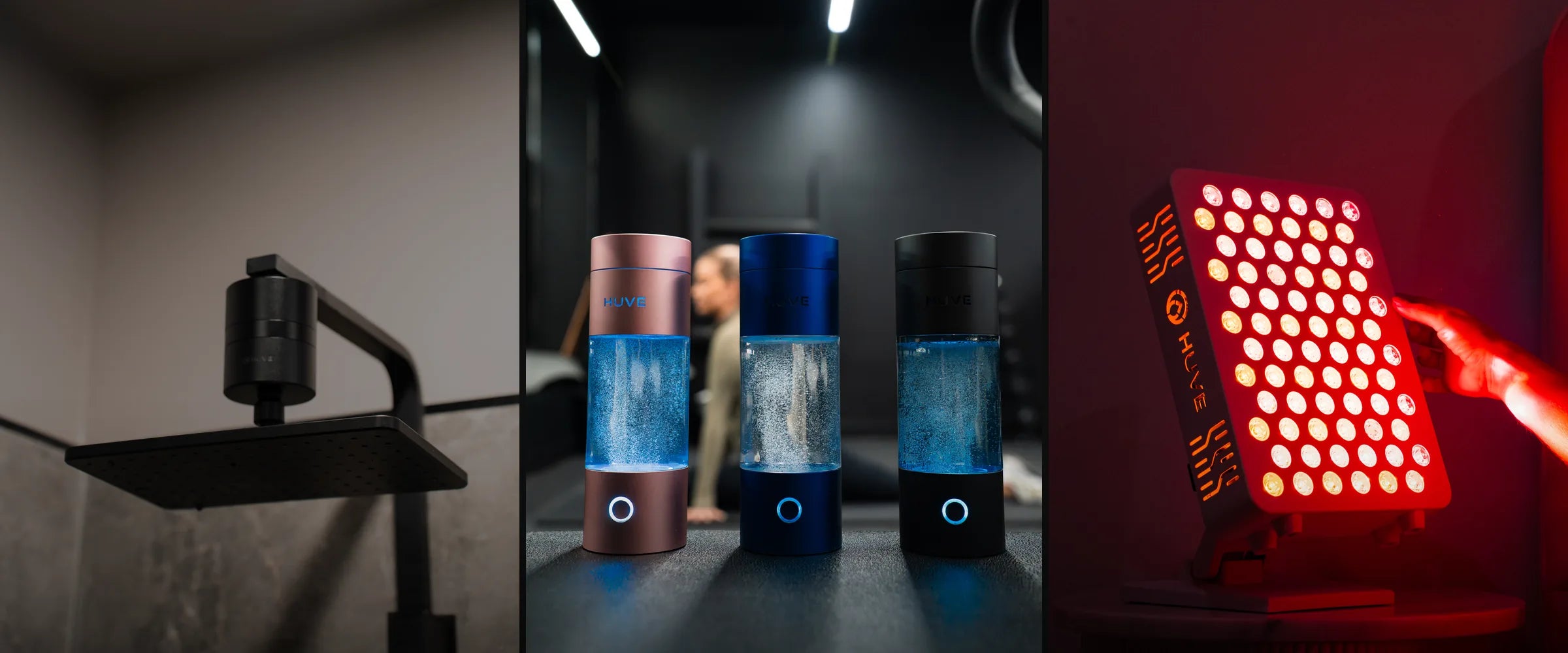
For example, independent H₂HUBB testing measured the HUVE Perform V2 at an average of 8.82 mg/L—approximately 8.82 ppm or 8,820 ppb—after its 10-minute cycle. In its 230 mL chamber, that equates to:
8.82 mg/L × 0.230 L = approximately 2.03 mg H₂ per serve
That total milligram dose is ultimately more informative than cycle length or a headline ppb number alone.
How should 3, 5, 10, 20 and 40-minute cycles be viewed?
The best duration is therefore not universal. It is the shortest practical cycle that reliably produces the dose a user wants.
What do published third-party test results show?
The following table uses each laboratory's published average concentration and dose results.
Swipe or scroll horizontally to view all columns.
Sources: HUVE Perform V2 H₂HUBB report, Echo Flask H2 Analytics results and Piurify 17 oz H₂HUBB report.
*Piurify's 40-minute test was completed using two consecutive 20-minute cycles, not a separate built-in 40-minute mode.
These results were not produced in one controlled head-to-head study. The bottles hold different water volumes, and Echo's H2 Analytics testing used static-headspace gas chromatography while the cited HUVE and Piurify tests used an electrochemical microsensor. The figures are most useful for showing how dose changed within each bottle as its cycle time increased; cross-product comparisons should be treated as indicative rather than laboratory-controlled rankings.
Echo Flask: twice the time delivered only 33% more H₂
Echo Water publishes the following H2 Analytics results for the Echo Flask:
- 10 minutes: 6.07 mg/L and a 2.17 mg dose
- 20 minutes: 8.25 mg/L and a 2.89 mg dose
Doubling the generation time from 10 to 20 minutes increased the reported dose by only 0.72 mg, or approximately 33%.
Viewed another way, the first 10 minutes delivered 2.17 mg. The second 10 minutes added just 0.72 mg—around one-third as much as the first 10-minute period.
The average dose-production rate consequently fell from approximately 0.217 mg per minute at 10 minutes to 0.145 mg per minute over the full 20-minute cycle.
The longer cycle produced more hydrogen in the bottle, but nowhere near twice as much.
Piurify: four times the generation time delivered less than twice the dose
H₂HUBB tested the 500 mL Piurify 17 oz Hydrogen Water Bottle at 10 minutes, 20 minutes and at 40 minutes using two consecutive 20-minute cycles:
- 10 minutes: 4.70 mg/L and a 2.35 mg dose
- 20 minutes: 7.20 mg/L and a 3.60 mg dose
- 40 minutes: 9.20 mg/L and a 4.60 mg dose
From 10 to 20 minutes, twice the generation time increased the dose by 1.25 mg, or approximately 53%.
From 20 to 40 minutes, another 20 minutes added only 1.00 mg—an increase of approximately 28% despite doubling the cycle time again.
Across the full comparison, four times the generation time increased the dose from 2.35 mg to 4.60 mg. That is less than twice the dose for four times the wait.
The average dose per minute fell from approximately 0.235 mg at 10 minutes to 0.115 mg at 40 minutes—less than half the original rate.
For some users, a larger 500 mL serving may be desirable. However, for users focused specifically on maximising H₂ dose per minute, the data clearly demonstrates diminishing returns from repeatedly extending a single fill.
HUVE Perform V2: independently verified performance in 10 minutes
H₂HUBB's testing of HUVE Perform V2 recorded:
- 5-minute average: 5.03 mg/L, or approximately 5,030 ppb
- 5-minute dose: approximately 1.16 mg in 230 mL
- 10-minute average: 8.82 mg/L, or approximately 8,820 ppb
- 10-minute peak: 9.30 mg/L, or approximately 9,300 ppb
- 10-minute dose: approximately 2.03 mg in 230 mL
- Chlorine and ozone: not detected in the reported testing
H₂HUBB recommended the HUVE 10-minute cycle as the optimal setting for practical use. It also reported that, at the time of testing, HUVE Perform produced the highest 10-minute dissolved hydrogen concentration H₂HUBB had measured across the hydrogen water bottles in its internal testing data.
Importantly, the average 8.82 mg/L result—not merely the 9.30 mg/L peak—is what produces the calculated 2.03 mg serving dose.
Why two fresh 10-minute HUVE serves can outperform one long cycle
If the goal is to maximise total H₂ intake over 20 minutes, a more productive strategy can be to generate and consume one fresh HUVE Perform V2 serving, refill the bottle and run a second 10-minute cycle.
Assuming each fresh fill reproduces H₂HUBB's tested average, the calculated result is:
2.03 mg + 2.03 mg = approximately 4.06 mg H₂ across two fresh serves in 20 minutes
Swipe or scroll horizontally to view all columns.
**The HUVE two-serve figure is a calculated scenario based on repeating H₂HUBB's independently measured 10-minute average; it was not itself a single 20-minute laboratory test.
On those published averages, two fresh HUVE servings would provide approximately:
- 40% more total H₂ than the Echo Flask's reported 20-minute result
- 13% more total H₂ than the Piurify bottle's reported 20-minute result
The same principle extends to 40 minutes. Four fresh HUVE 10-minute servings would calculate to approximately 8.12 mg H₂, compared with Piurify's reported 4.60 mg after 40 minutes on one 500 mL fill. That comparison involves different total water volumes—920 mL across four HUVE servings versus 500 mL in the Piurify bottle—but it illustrates the difference between repeatedly preparing fresh high-concentration servings and continuing to run the same water through progressively lower-return cycles.
Why a compact 230 mL serving is a performance feature
Hydrogen water is different from ordinary water stored for all-day sipping. Molecular hydrogen is a small dissolved gas. Once the bottle is opened and pressure is released, hydrogen begins to leave the water, with the rate influenced by factors such as temperature, agitation, exposed surface area and storage conditions.
That makes prompt consumption important when the objective is to ingest as much of the measured dose as practical.
HUVE Perform V2's 230 mL capacity is intentionally compact. It provides a serving that can be consumed promptly after generation, helping reduce the opportunity for H₂ to dissipate before it is ingested. The bottle can then be refilled to prepare another fresh serving when desired.
This serving-based approach prioritises:
- High independently verified concentration
- A meaningful dose in a small volume
- Practical 10-minute preparation
- Prompt consumption after opening
- Fresh generation rather than prolonged storage
It does not guarantee how much hydrogen any individual will absorb or a particular health outcome, but it helps maximise the amount of the measured dissolved dose that is actually consumed.
Does a shorter cycle use the battery more efficiently?
Longer electrolysis cycles keep the cell operating for longer and use more of the bottle's available running time. When a long cycle produces progressively smaller additions of dissolved H₂, that extra operating time may be less productive from a dose-per-minute perspective.
The available reports do not provide sufficient electrical power data to calculate and compare watt-hours per milligram of dissolved H₂ across all three bottles. It is therefore more accurate to describe HUVE's advantage here as cycle-time and dose efficiency—not to claim a controlled electrical-efficiency result that was not tested.
In practical terms, HUVE Perform V2 delivers approximately 2.03 mg in 10 minutes, without requiring a user to keep the bottle running for 20 or 40 minutes to obtain a meaningful serving.
How does the HUVE dose compare with the IHSA benchmark?
The International Hydrogen Standards Association establishes a minimum benchmark of 0.5 mg of H₂ consumed in no more than one litre of product water. It also requires hydrogen-water generating devices to produce at least 0.5 mg/L.
HUVE Perform V2's independently measured 10-minute average equates to approximately 2.03 mg H₂ in only 230 mL.
2.03 mg ÷ 0.5 mg = approximately 4.1 times the IHSA minimum dose benchmark
The IHSA notes that further research is required to determine minimum effective doses and concentrations for different individuals and circumstances. The comparison is therefore a performance benchmark, not a promise of a specific therapeutic effect.
The better question is dose per practical serving—not the longest timer
A 20 or 40-minute cycle is not automatically superior simply because it runs for longer.
Published Echo Flask and Piurify results show that extended cycles can produce more dissolved H₂ from one fill, but with clearly diminishing returns. Doubling or quadrupling the waiting time did not produce a proportional increase in dose.
HUVE Perform V2 takes a more practical approach:
- Approximately 8,820 ppb average dissolved H₂ in 10 minutes
- Approximately 2.03 mg H₂ in a compact 230 mL serving
- Around 4.1 times the IHSA 0.5 mg minimum dose benchmark in one serve
- A serving size designed to be consumed promptly
- The ability to refill and prepare another fresh high-concentration serving
- Independently reported testing with no detectable chlorine or ozone
For users who want to maximise independently verified hydrogen dose without waiting 20 or 40 minutes for one bottle, HUVE Perform V2 is the clear choice.
Hydration. Elevated.
Frequently asked questions
Is a longer hydrogen water bottle cycle always better?
No. A longer cycle may increase concentration and dose, but published bottle tests show that the increase can become progressively smaller. Performance should be assessed using independently measured concentration, total H₂ dose, water volume and cycle time together.
Does a 20-minute hydrogen cycle produce twice as much H₂ as 10 minutes?
Not in the cited Echo Flask or Piurify testing. Echo's reported dose increased from 2.17 mg to 2.89 mg, while Piurify's increased from 2.35 mg to 3.60 mg. Both increased, but neither doubled.
What is the best hydrogen water bottle cycle duration?
There is no universal best duration. The most practical cycle is the shortest one that delivers a meaningful independently verified dose. For HUVE Perform V2, H₂HUBB recommended the 10-minute setting.
How much hydrogen does HUVE Perform V2 produce in 10 minutes?
H₂HUBB measured an average concentration of 8.82 mg/L, approximately 8,820 ppb, and a peak of 9.30 mg/L. In the tested 230 mL volume, the average equates to approximately 2.03 mg H₂ per serve.
Is ppb the same as hydrogen dose?
No. PPB measures concentration. Total dose depends on both concentration and the volume consumed. Multiply mg/L by the serving volume in litres to calculate the approximate milligram dose.
Should hydrogen water be consumed immediately?
It is best consumed promptly after the generation cycle and opening the bottle. Dissolved hydrogen begins to escape once pressure is released and the water is exposed, so prompt consumption helps maximise the amount of the measured dose that is ingested.
Why not simply run repeated cycles on the same water?
Repeated cycles may continue to increase concentration, but the cited results show diminishing incremental gains. Preparing and consuming fresh high-concentration servings can deliver more total H₂ over the same period, provided the additional water volume suits the user's hydration needs.
Product results can vary by individual unit, water quality, temperature, fill level, cycle procedure and testing method. Comparisons are based on the cited published reports and are not a controlled head-to-head laboratory study. Calculated multi-serve HUVE figures assume each fresh cycle repeats H₂HUBB's measured average. This article provides general information and is not medical advice. Research into hydrogen-rich water is continuing, and no specific health outcome is guaranteed.