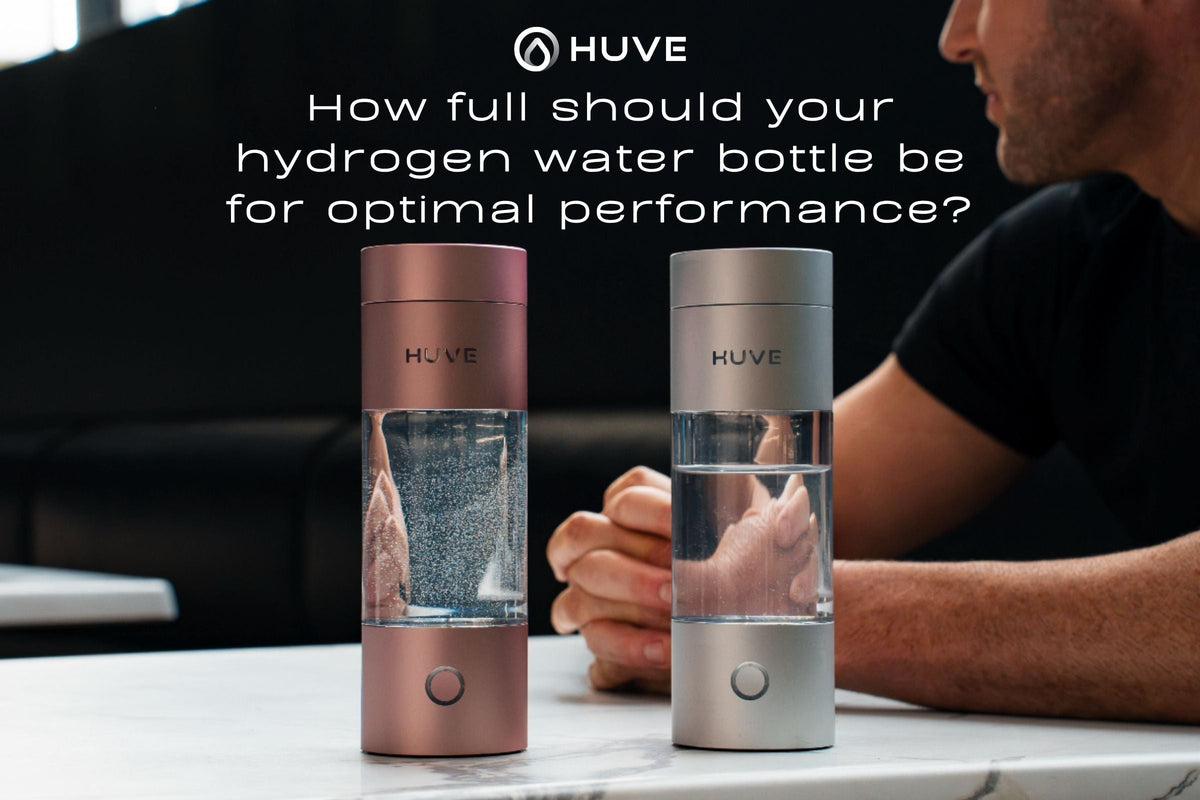
For optimal hydrogen production, fill the HUVE Perform to its normal full level of approximately 230 mL before starting a hydrogen cycle. You can safely run a cycle with less water, provided the bottle contains at least 50 mL, but a partial fill is not recommended for optimal performance. If you prefer smaller drinks, generate with a full bottle and drink comfortable portions.
Can you use just 100–120 mL in your hydrogen water bottle? Do you need to drink the whole bottle immediately? And does less water mean more concentrated hydrogen?
These are practical questions, especially if you prefer smaller servings. Here is HUVE's guidance on fill level, dissolved hydrogen and getting the most from your HUVE Perform.
How full should HUVE Perform be for optimal performance?
HUVE's minimum operating volume is 50 mL. That means running a hydrogen-generation cycle with 100–120 mL is permitted. The recommended fill for optimal performance remains approximately 230 mL.
| Water volume | Can you run a hydrogen cycle? | HUVE guidance |
|---|---|---|
| Below 50 mL | No | Below the minimum operating volume. |
| 50 mL to less than a full fill | Yes | Permitted, but not recommended for optimal hydrogen production. |
| Normal full fill, approximately 230 mL | Yes | Recommended before each hydrogen-generation cycle. |
The 50 mL figure is an operating minimum. It is not our recommended serving size or a promise of the bottle's published hydrogen output at that volume.
Why does HUVE recommend running the bottle full?
HUVE Perform generates molecular hydrogen gas through electrolysis and dissolves it into water. Its sealed chamber allows pressure to build during the generation cycle, supporting higher dissolved-hydrogen concentrations.
Using less water leaves more space for gas above the water. This changes the conditions inside the bottle, including how pressure develops and how hydrogen distributes between the water and the gas space.
Less water does not automatically mean stronger hydrogen water. You cannot assume that filling the bottle halfway will double its hydrogen concentration, or that it will reproduce the results measured with a full bottle.
For consistent use, fill HUVE Perform to its normal full level, secure the cap and run your chosen cycle.
How much hydrogen will a half-full bottle produce?
The full-bottle results discussed here do not establish an exact hydrogen concentration for a 100–120 mL fill. The comparison below illustrates a lower-pressure scenario; a reliable partial-fill figure would require testing at that specific water volume and cycle setting.
Fill level, water temperature, cycle duration and the time between generation and drinking can all affect the result. This is why we recommend using the full fill rather than estimating partial-fill performance from a headline ppm or ppb figure.
For more on how generation time affects output, read our guide to hydrogen water bottle cycle times.
Full versus half full: how does the hydrogen dose compare?
Hydrogen concentration and serving volume both matter. To calculate the dissolved hydrogen in a serving, multiply concentration in milligrams per litre by water volume in litres:
Hydrogen concentration (mg/L) × water volume (L) = dissolved hydrogen dose (mg).
In H2HUBB's testing of HUVE Perform V1, a full 230 mL bottle reached a peak of 6,070 ppb on the 10-minute cycle. Its measured average was 5,600 ppb, corresponding to approximately 1.3 mg of dissolved hydrogen per full serving.
The table compares those measured full-fill concentrations with an illustrative half-fill scenario. If a 115 mL fill does not develop sufficient hydrogen pressure during a 10-minute cycle to exceed the near-atmospheric hydrogen saturation level, a concentration around 1,600 ppb would provide only 0.184 mg of dissolved hydrogen.
| Example | Water volume | Cycle | Hydrogen concentration | Calculated dose |
|---|---|---|---|---|
| Full fill: H2HUBB measured average | 230 mL | 10 minutes | 5,600 ppb (5.60 mg/L) | 1.288 mg, approximately 1.3 mg |
| Full fill: H2HUBB measured peak | 230 mL | 10 minutes | Up to 6,070 ppb (6.07 mg/L) | 1.396 mg, approximately 1.40 mg |
| Half fill: example atmospheric-pressure scenario | 115 mL | 10 minutes | Approximately 1,600 ppb (1.60 mg/L), assumed | 0.184 mg, approximately 0.18 mg |
The approximately 1,600 ppb reference describes hydrogen equilibrium near room temperature at a hydrogen partial pressure of approximately one atmosphere, as explained in H2HUBB's hydrogen-water science guide. Temperature, pressure and preparation conditions affect the concentration.
In this example, the 0.184 mg half-fill dose is approximately 86% lower than the full-fill dose calculated from H2HUBB's measured average. It is also below the IHSA's 0.5 mg daily dose benchmark when consumed as a single serving.
For comparison, a 115 mL portion taken from a fully generated bottle at the measured average of 5.60 mg/L would contain approximately 0.64 mg before further hydrogen loss. This illustrates why HUVE recommends generating with a full bottle, then drinking smaller portions if preferred.
Why doesn't HUVE sell or recommend glass hydrogen water bottles?
HUVE does not sell or recommend glass hydrogen water bottles for high-performance portable use. We choose a Tritan chamber to support pressure-based hydrogen generation and everyday durability.
Glass is rigid and brittle. Pressure, damage and impacts can create breakage risks, so the complete bottle must be engineered and validated for its operating conditions. Some glass hydrogen bottle designs vent gas or limit pressure to manage these concerns, restricting how much hydrogen they retain in the water.
For an unpressurised design operating near the one-atmosphere hydrogen equilibrium level, a concentration around 1,600 ppb would provide only 0.184 mg in 115 mL, or 0.368 mg in 230 mL. Those are substantially smaller doses than HUVE Perform V1's independently measured full-fill average. A small serving at this concentration would not, by itself, reach the IHSA's 0.5 mg daily benchmark.
Glass material alone does not impose a universal 1,600 ppb ceiling: some engineered glass systems operate under pressure and have independently measured higher output. HUVE's preference is based on the combination of pressure performance, impact resistance and practicality for a portable bottle.
Read more about HUVE's material choice in our Tritan, polycarbonate and glass hydrogen water bottle comparison. When assessing any bottle, look for independently measured concentration, serving dose and validated pressure performance.
What if I only want to drink 100–120 mL at a time?
Fill the bottle fully for generation, then drink a smaller portion. You do not need to gulp the entire 230 mL in one go.
- Fill HUVE Perform to its normal full level of approximately 230 mL.
- Secure the cap and run the 10-minute hydrogen-generation cycle according to the product instructions.
- Drink 100–120 mL, or another amount that feels comfortable.
- If you want the remainder, drink it soon afterwards to retain more of the dissolved hydrogen.
This lets you use the recommended generation volume while keeping your drinking portions manageable.
Do I need to drink hydrogen water immediately?
Drinking it promptly helps maximise the dissolved hydrogen you consume, but you can take smaller sips. Hydrogen gradually escapes after the bottle is opened.
In HUVE's published H2 Analytics dissipation testing, the tested bottle remained open after a full-fill 10-minute cycle:
| Time after opening | Measured hydrogen concentration | Calculated hydrogen in 230 mL |
|---|---|---|
| Immediately | 5.88 mg/L | 1.35 mg |
| 30 minutes | 4.05 mg/L | 0.93 mg |
| 60 minutes | 3.17 mg/L | 0.73 mg |
| 90 minutes | 2.61 mg/L | 0.60 mg |
| 120 minutes | 2.32 mg/L | 0.53 mg |
Source: H2 Analytics laboratory report H2AR-260212-1. Concentrations and calculated amounts are rounded.
These results show that hydrogen remained measurable for two hours under the test conditions. The test used a full fill and periodic sampling; it did not test someone drinking half and leaving the remainder. The figures therefore do not guarantee the hydrogen remaining in a partly consumed bottle.
The practical approach is to drink at a comfortable pace and finish sooner when convenient. Earlier consumption retains more of the starting hydrogen.
Can you run any hydrogen water bottle half full?
Check the manufacturer's instructions for your specific bottle. Minimum water volumes and recommended fill levels can differ between designs.
The 50 mL minimum and approximately 230 mL recommended fill in this guide apply to HUVE Perform. They should not be used as operating instructions for another hydrogen water bottle.
Frequently asked questions
Can I run the HUVE Perform half full?
Yes. A half-full HUVE Perform contains approximately 115 mL, which exceeds HUVE's 50 mL minimum operating volume. For optimal hydrogen production, we recommend generating with a full fill of approximately 230 mL.
Can I run HUVE Perform with only 100 mL of water?
Yes, 100 mL is above the 50 mL operating minimum. However, partial filling is not recommended for optimal output. Prepare a full bottle and drink a 100 mL portion if that suits you better.
What is the minimum recommended water volume?
The minimum operating volume is 50 mL. The recommended volume for optimal hydrogen generation is the normal full fill of approximately 230 mL.
Will using less water make hydrogen water more concentrated?
Not necessarily. Less water changes the gas space and pressure conditions inside the bottle. You cannot calculate partial-fill concentration simply by dividing the full-bottle output by a smaller water volume.
Can I drink half now and half later?
Yes. Generate with a full fill, then drink portions that suit you. Dissolved hydrogen decreases after opening, so drinking the remainder sooner helps retain more hydrogen. Published full-fill retention results do not guarantee the same figures in a partly consumed bottle.
If I can't drink 230ml straight away, how can I get the maximum dosage?
Run a hydrogen cycle with the bottle fully filled, then drink portions that suit you and when you're ready to drink more, Refill the bottle and run another cycle and drink the amount that suits you when the cycle completed. This will help ensure you get the maximum hydrogen dosage.
Get the most from your HUVE Perform
For everyday use, our recommendation is straightforward: generate with a full bottle, then drink at a pace that works for you.
Have a question about your bottle? Email support@huve.com.au for HUVE Perform guidance, or explore the HUVE Perform hydrogen water bottle.
Hydration. Elevated.