A “BPA-free” label can be completely accurate while leaving an important question unanswered: what was used instead?
Some products replace bisphenol A (BPA) with related chemicals such as bisphenol S (BPS). These alternatives can raise similar concerns about hormone disruption and reproductive health. Germany’s Federal Institute for Risk Assessment specifically warns that BPA-free plastic drinking bottles may still contain other bisphenols, including BPS. Read the BfR guidance.
That is why our recommendation is straightforward: only choose a bottle confirmed to be both BPA-free and BPS-free.
Our existing Tritan vs Glass vs Polycarbonate guide explores how bottle materials affect durability, portability and suitability for hydrogen generation. Understanding BPA and its substitutes adds another important consideration: the chemistry behind the material.
BPA is an industrial chemical used to manufacture conventional polycarbonate plastics and certain epoxy resins. It can migrate from some food-contact materials into food or drinks, with temperature influencing how much is released. These exposure concerns help explain why consumers look for BPA-free bottles. National Institute of Environmental Health Sciences.
However, “BPA-free” is a claim about one substance. It does not automatically establish that a product is free from BPS, other bisphenols or every chemical that could affect hormone activity.
BPS belongs to the same chemical family as BPA and is used in certain plastics, coatings and other consumer products. Biomonitoring California explicitly advises that products marketed as BPA-free might contain BPS. It identifies possible concerns including interference with natural hormones, effects on the reproductive system and harm to the developing fetus or infant. Biomonitoring California’s BPS guidance.
The concern therefore extends beyond the presence or absence of BPA. Replacing it with a related substance requires evidence that the replacement is suitable for its intended use.
Research supports asking those questions. A US National Toxicology Program assessment found that many BPA alternatives showed biological activity within the range observed for BPA. This does not establish that every substitute has identical effects or that every bottle presents the same risk; actual risk depends on exposure as well as a substance’s hazards. It does show why a different chemical name is insufficient evidence of improved safety. National Toxicology Program assessment.
For consumers comparing bottle materials, the distinctions matter:
| Material | What to check |
|---|---|
| Conventional polycarbonate, or PC | BPA is commonly used in its manufacture. Obtain clear material specifications and evidence supporting any BPA-free and BPS-free claims. |
| Tritan™ copolyester | Eastman, its manufacturer, states that Tritan is free from BPA, BPS and other bisphenols. Confirm the bottle uses genuine Tritan and check the other components that contact water. |
| Glass | The glass body is free from BPA and BPS. Check the lid, seals, liners and other water-contact components, along with the complete bottle’s suitability for its intended use. |
Eastman’s explanation is particularly relevant: Tritan is a copolyester manufactured without BPA or BPS. Its BPA-free status comes from its different chemistry. Eastman’s Tritan FAQs.
Whichever material you prefer, look beyond the bottle body. Water may also contact the underside of the lid, seals, internal fittings or coatings. A statement about the chamber material alone leaves those components unaddressed.
Before buying, look for:
- Explicit confirmation of both BPA-free and BPS-free status.
- Clear identification of the materials used throughout the water-contact components.
- Supporting documentation, with any test report identifying the product, substances tested and testing conditions.
- Clear use and cleaning instructions appropriate to the complete bottle.
If a supplier only repeats “BPA-free” when asked about BPS, the question remains unanswered.
For hydrogen water bottles, these checks sit alongside the engineering requirements discussed in our original guide. The chamber, cap, seals and pressure-management system must work together. Material selection is one part of assessing the complete product.
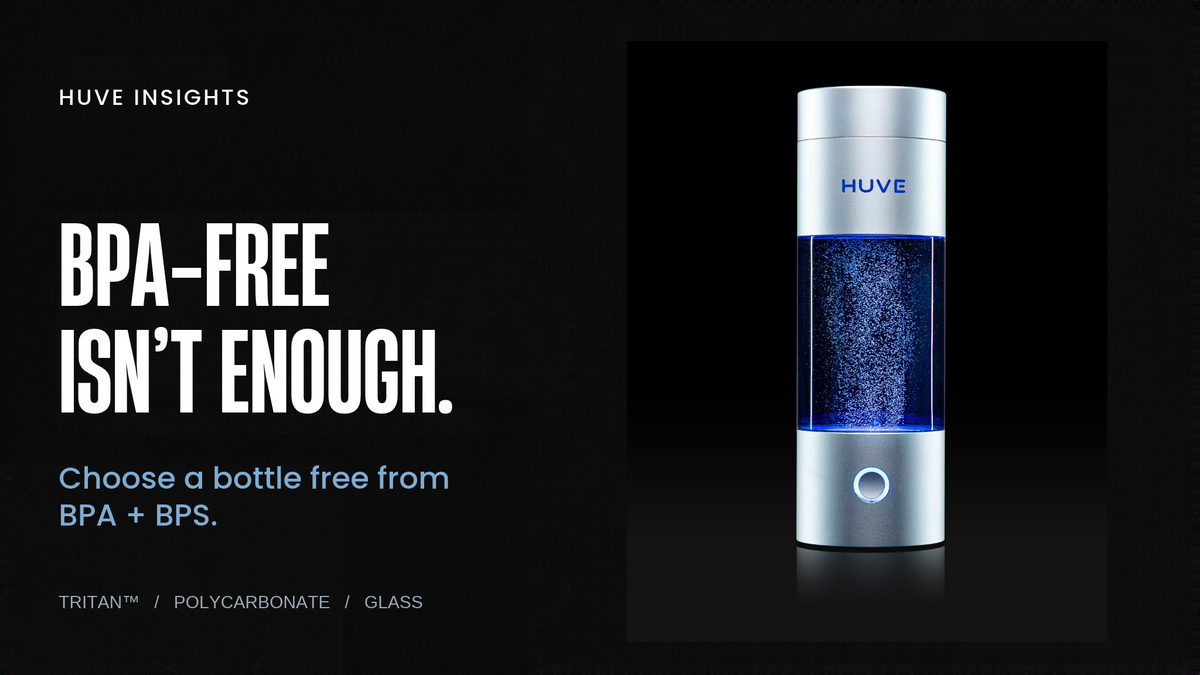
HUVE Perform uses a BPA- and BPS-free Tritan™ drinking chamber, combining transparency with a lightweight, impact-resistant design suited to everyday portable use. Read more about HUVE Perform’s construction.
When choosing your next bottle, make both claims part of your purchasing criteria: BPA-free and BPS-free, supported by clear information about the materials that contact your water.