The HUVE Perform V2 can make a cleaning solution inside the bottle using a measured amount of salt and water. In its report dated 23 November 2026, H2HUBB tested how much free chlorine and ozone the bottle produced during its dedicated self-cleaning cycle.1
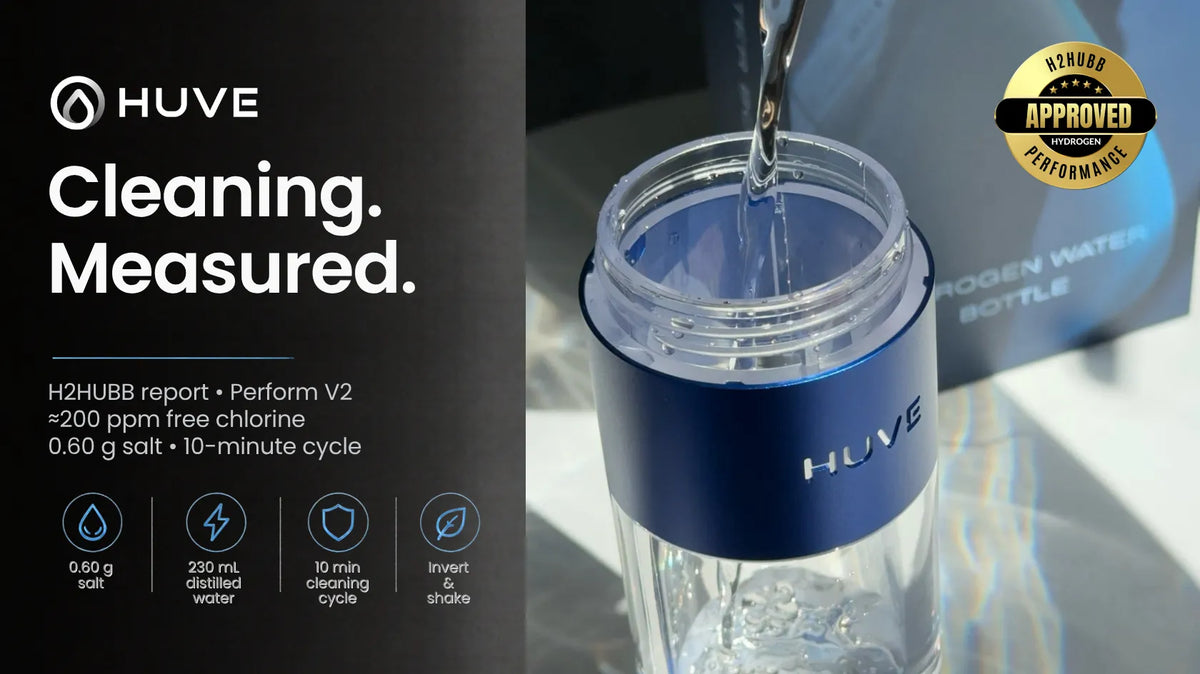
H2HUBB’s preferred test recipe was 0.60 g of salt in 230 mL of distilled water, followed by one 10-minute self-cleaning cycle. It produced approximately 200 ppm free chlorine. Here is what that result means and how to follow HUVE’s cleaning procedure.
This salt-assisted method is for cleaning only. Do not drink the cleaning solution or add salt for a normal hydrogen-water drinking cycle. Discard the solution and thoroughly rinse the bottle before refilling it with fresh drinking water.
Independent testing beyond hydrogen performance
HUVE engaged H2HUBB to review the HUVE Perform V2 cleaning mode as part of our ongoing commitment to independent third-party testing across all HUVE products. Our testing programme looks beyond hydrogen output to the features that matter in everyday use.
For HUVE Perform, we have already commissioned hydrogen retention and dissipation testing by H2 Analytics. H2HUBB’s cleaning-cycle assessment now extends that work by measuring the free chlorine and ozone produced in self-cleaning mode.
We commission these additional reviews to inform ongoing product development and help ensure the HUVE Perform V2 meets and exceeds customer expectations.
What H2HUBB tested
H2HUBB used 230 mL of distilled water at 18–21°C (64.4–69.8°F), starting at pH 5.8, and added six precisely weighed quantities of sodium chloride (NaCl). After each 10-minute self-cleaning cycle, it measured free chlorine, dissolved ozone and final pH. The report says each condition was tested multiple times.1
In self-cleaning mode, the bottle uses electricity and dissolved salt to produce cleaning agents in the water. This is a separate setting from the normal hydrogen-water drinking cycle.
| Salt added | Free chlorine | Dissolved ozone | Final pH |
|---|---|---|---|
| 0.15 g | ≈25 ppm | 0.00 ppm | 3.7 |
| 0.30 g | ≈50 ppm | 0.05 ppm | 3.3 |
| 0.45 g | ≈100 ppm | 0.10 ppm | 3.0 |
| 0.60 g | ≈200 ppm | 0.20 ppm | 3.1 |
| 0.75 g | ≈200 ppm | 0.20 ppm | 2.9 |
| 1.00 g | ≈350 ppm | 0.30 ppm | 2.8 |
Source: H2HUBB report, page 2. Ppm means parts per million. The chlorine readings are approximate measurements of free chlorine; HOCl was not measured separately.
Why HUVE recommends 0.60 g of salt
H2HUBB selected 0.60 g (600 mg) of sodium chloride in 230 mL of distilled water as its preferred tested recipe. This amount produced approximately 200 ppm free chlorine and 0.20 ppm ozone, with a final pH of 3.1.1
Increasing the salt to 0.75 g did not increase the measured chlorine or ozone. The 1.00 g test produced more free chlorine, but the smaller 0.60 g amount was enough to reach H2HUBB’s preferred output. Weigh the recommended amount rather than adding extra salt.
HOCl, sanitation and sterilisation: what the numbers mean
HOCl is short for hypochlorous acid, one of the chlorine-based agents that can act against microorganisms. H2HUBB measured free chlorine, reported as Cl₂/HOCl. It did not measure HOCl separately. The water’s acidity affects the mix of chlorine compounds, so the 200 ppm reading should be understood as free chlorine rather than 200 ppm of HOCl alone.1
For context, published surface-sanitation guidance gives the following concentration and contact conditions:
- Health Canada: its biocides monograph lists hypochlorous acid at 140–200 ppm available chlorine for bacteria on food-premises surfaces, with a minimum one-minute contact time at 18–25°C (64.4–77°F).2
- Food Standards Australia New Zealand: its general food-contact sanitation guidance includes chlorine at 100 ppm in water at least 13°C (55.4°F), with the correct contact conditions and instructions also required.3
The bottle’s approximately 200 ppm result reaches the upper end of the Health Canada concentration range and exceeds the FSANZ concentration benchmark. These are comparisons of concentration; they do not establish equivalent microbial performance or regulatory approval for HUVE. Health Canada’s one-minute contact time applies to the specified surface-sanitiser conditions, not to the bottle’s operating cycle.
Cleaning removes residue. Sanitising reduces microorganisms to an acceptable level; sterilisation destroys all forms of microbial life, including spores. There is no universal HOCl concentration that guarantees sterilisation. The result depends on the solution, acidity, temperature, surface cleanliness, organism and how long the surface stays wet with the solution.3, 4
H2HUBB measured the cleaning agents produced by the bottle. Its tests did not measure microbial survival inside the bottle. The chlorine reading was taken after the cycle and does not show that the same concentration was present for all 10 minutes. The report gives a measured result for the cleaning solution under its test conditions.
How often should you clean your bottle?
Empty and wash a reusable drinking bottle daily after use. This follows advice from Australia’s Food Safety Information Council. For HUVE Perform V2, follow the part-specific care instructions below: handwash the detached bottle body, keep detergent away from the lid and generator, and protect the base exterior and charging port from water.5, 6
Daily washing and the salt-assisted procedure serve different care needs. HUVE’s general care guide also recommends a weekly water-only cleaning cycle. The food-safety guidance and H2HUBB report cited here do not set a repeat schedule for this salt-assisted method. For routine maintenance, see HUVE’s bottle care guide.1, 6
The cleaning guide / 7 steps
How to clean your HUVE Perform V2
HUVE recommends the following cleaning procedure, based on H2HUBB’s tested salt-and-water recipe, with HUVE’s additional steps for covering the cap and threads, rinsing and reassembly.1

Step 01
Start with clean surfaces
Disconnect the charging cable and empty the bottle. Detach the bottle body and handwash it with mild, unscented dishwashing liquid, then rinse thoroughly before reattaching it to the base. Keep detergent away from the lid and generator. Keep the base exterior and charging port dry; only its internal water-contact surfaces should contact liquid. Do not immerse the base or dismantle the hydrogen cell.6

Step 02
Weigh the salt
Measure 0.60 g of plain sodium chloride using a precision digital scale suitable for weighing less than 1 g. A kitchen scale that displays only whole grams cannot measure this amount reliably. Do not estimate with a pinch or teaspoon.

Step 03
Prepare the water
For this report-based recipe, fully dissolve the salt in 230 mL of distilled water at 18–21°C (64.4–69.8°F). These are the conditions H2HUBB tested; using different water or temperatures may change the output. Fill no higher than the base of the lid threads and respect the bottle’s fill limit.

Step 04
Run the cleaning cycle
Keep the assembled bottle upright and fit the cap tightly. Press the power button three times in quick succession to activate self-cleaning mode. Allow the full 10-minute cycle to finish. This is the time the bottle operates to produce the cleaning solution; the cap and thread steps come next.

Step 05
Wet the cap and upper surfaces
After the cycle ends, make sure the cap is secure, then invert and gently shake and rotate the bottle so the solution reaches the upper walls, cap underside and accessible threads. Continue to Step 06.

Step 06
Treat the top and bottom threads
Remove the lid and pour the cleaning solution into a small bowl. Unscrew the bottle body from the base and set the base aside with its exterior and charging port kept dry. Dip the top threaded end of the bottle body into the solution and move it in a gentle stirring motion for 30 seconds. Repeat with the bottom threaded end for another 30 seconds. Keep the base out of the bowl.

Step 07
Discard, rinse and reassemble
Do not drink the cleaning solution. Discard it, then thoroughly rinse the bottle body, cap, threads and internal water-contact surfaces with fresh drinking water, ideally filtered. Keep the base exterior and charging port dry. Air-dry the bottle body and lid with the lid off, then reattach the bottle body to the base as directed in the user guide. Refill with fresh drinking water before the next drinking cycle.
Use salt and water alone for this cleaning cycle. Do not add vinegar, citric acid, bleach or other cleaning chemicals. Descaling is a separate maintenance task and should follow the user guide.
A small recipe with measurable output
H2HUBB measured approximately 200 ppm free chlorine from 0.60 g of salt in 230 mL of distilled water after one 10-minute self-cleaning cycle. HUVE’s guide above turns that tested recipe into a practical care sequence: prepare the solution, run the cycle, wet the cap and threads, then discard, rinse and reassemble. Read the full H2HUBB report for its methods, results and limitations.
This badge recognises H2HUBB’s hydrogen-water product assessment. The separate sanitation report linked above measures the cleaning solution produced during self-cleaning mode.
References
- H2HUBB. HUVE Perform V2 sanitation test report, 23 November 2026. Methods and results: pages 1–2; interpretation and recommendations: pages 4–5.
- Health Canada. Biocides monograph. Hypochlorous acid concentration and contact conditions.
- Food Standards Australia New Zealand. Safe Food Australia, Appendix 6: Cleaning and sanitising surfaces and utensils.
- Centers for Disease Control and Prevention. Introduction, methods, definition of terms: disinfection and sterilisation.
- Food Safety Information Council. Reusable food containers and food safety. Daily washing advice for reusable water bottles.
- HUVE. How to clean your HUVE Perform: a three-stage care guide. Part-specific care and routine water-only cleaning.