The best hydrogen water bottle capacity is a serving you can comfortably finish soon after hydrogen generation.
A larger bottle may hold more water, but if it takes longer to drink, more dissolved hydrogen can escape before you consume it.
That is why HUVE recommends choosing a serving you can finish within approximately 15 minutes of the cycle completing.
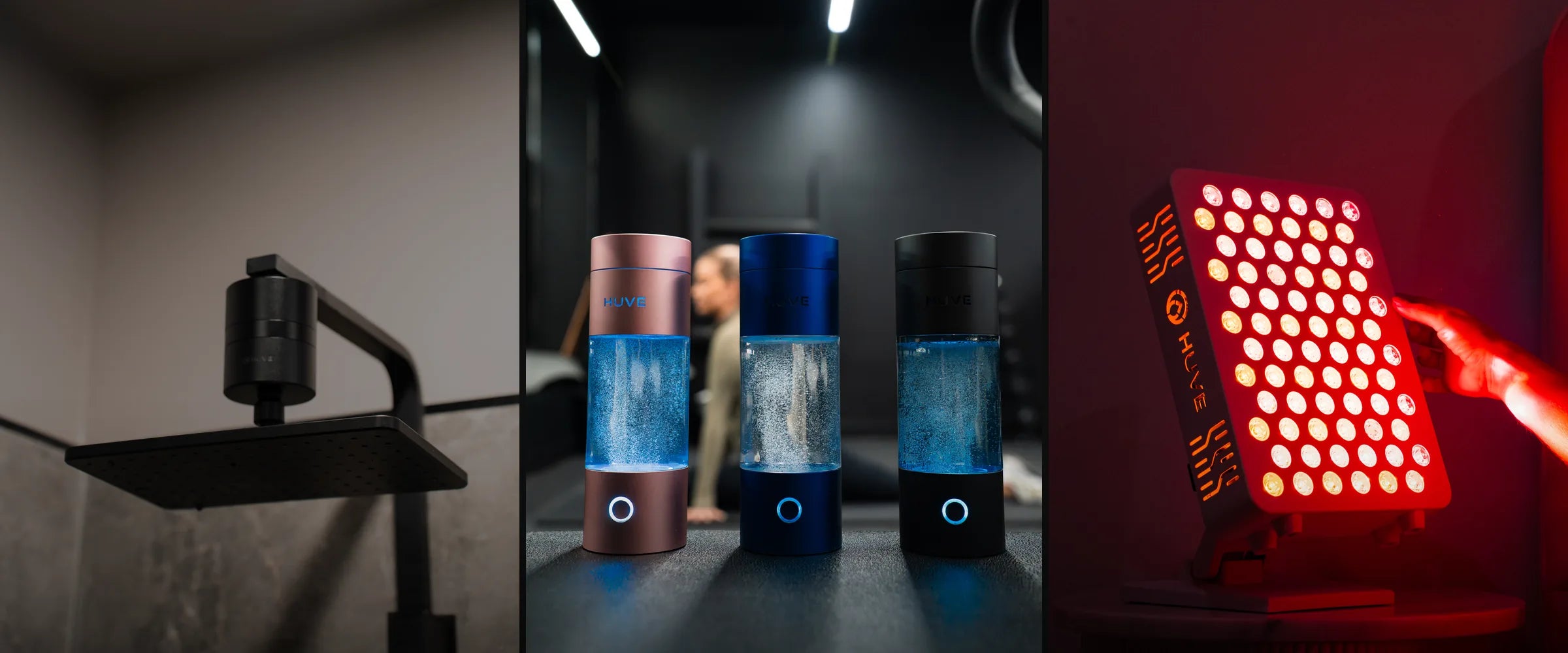
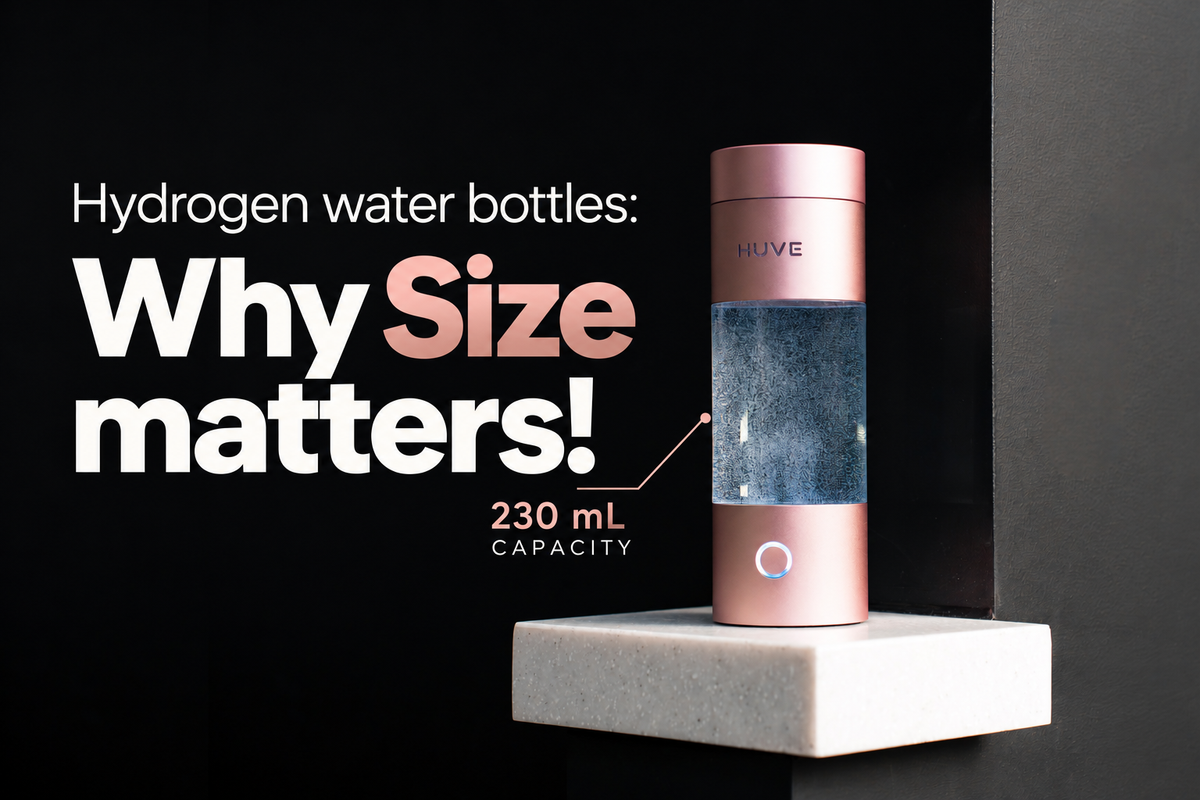
Both the HUVE Perform V1 and V2 hold 230 mL: a practical serving size designed for fresh hydrogen water, with a 10-minute generation cycle.
Explore the HUVE Perform range.
Why does hydrogen water bottle size matter?
Hydrogen water contains dissolved molecular hydrogen, or H₂. After generation, that hydrogen can gradually leave the water, particularly once the bottle is opened and pressure is released.
A larger serving can take longer to finish. That extra drinking time gives hydrogen more opportunity to escape before it reaches you.
The connection is straightforward:
Longer drinking time → more opportunity for dissipation → less hydrogen available to consume and absorb.
Size alone does not determine how quickly hydrogen dissipates. Temperature, pressure, bottle construction and handling also affect retention. The practical concern is how long you leave the water before finishing it.
Hydrogen that has escaped into the surrounding air is no longer part of your drinking dose. Consuming your serving promptly helps preserve the hydrogen available for absorption, although it does not establish exactly how much your body absorbs.
Concentration and dose: understand what you are drinking
When comparing hydrogen water bottles, distinguish between two measurements:
- Concentration, measured in mg/L: how much hydrogen is dissolved in each litre.
- Dose, measured in mg: the total hydrogen contained in the serving.
The calculation is:
Hydrogen concentration (mg/L) × serving volume (L) = hydrogen dose (mg).
For example, a 1-litre bottle containing 1 mg of hydrogen has a concentration of 1 mg/L.
That exceeds the International Hydrogen Standards Association’s minimum concentration benchmark of 0.5 mg/L. IHSA also specifies a minimum daily dose benchmark of 0.5 mg within no more than 1 litre of product water, alongside other certification requirements. Read the IHSA standards.
However, consuming that entire 1-litre serving promptly may be uncomfortable or impractical. If you sip it over an extended period, significant amounts of hydrogen can dissipate before you finish.
The hydrogen present when the cycle ends and the hydrogen you eventually consume are therefore different considerations.
What does HUVE’s hydrogen dissipation testing show?
As HUVE’s article on H₂ Analytics dissipation testing explains:
“What truly matters is how much dissolved hydrogen remains available over time”
H₂ Analytics tested the original HUVE Perform after a 10-minute cycle, leaving the bottle open and measuring hydrogen at 30-minute intervals.
| Time after opening | Dissolved H₂ concentration | Calculated H₂ in a 230 mL serving |
|---|---|---|
| Immediately | 5.88 mg/L | 1.35 mg |
| 30 minutes | 4.05 mg/L | 0.93 mg |
| 60 minutes | 3.17 mg/L | 0.73 mg |
| 120 minutes | 2.32 mg/L | 0.53 mg |
The concentration was approximately 31% lower after 30 minutes. These results describe the tested bottle under laboratory conditions; they are not a universal dissipation rate for every bottle or drinking pattern. View the H₂ Analytics laboratory report.
The practical lesson is to drink your hydrogen water while it is fresh.
HUVE’s 15-minute recommendation limits the time available for hydrogen to escape and helps preserve more of the starting dose. The test did not include a 15-minute measurement, so it does not establish an exact retention percentage at that point.
Larger bottles need more hydrogen to reach the same concentration
More water requires more dissolved hydrogen to achieve the same concentration.
For example, reaching 5 mg/L requires:
- 1.15 mg of dissolved hydrogen in 230 mL
- 5 mg of dissolved hydrogen in 1 litre
The larger volume needs approximately 4.35 times as much dissolved hydrogen.
With comparable generation efficiency and retention, producing that additional hydrogen generally requires more operating time or greater electrical input. Longer operation also consumes more energy and reducing the battery requiring more frequent charging.
Actual performance depends on the complete bottle design. Capacity alone cannot establish which product uses more power or delivers the better dose.
What should you look for in a hydrogen water bottle?
1. A capacity you can comfortably finish within 15 minutes
Choose a serving that fits how you actually drink.
For many people, 230 mL is a manageable amount to consume within 15 minutes, without feeling pressured to finish a large bottle quickly. This is why HUVE Perform V1 and V2 use a compact 230 mL serving.
Fill the bottle correctly, complete the cycle and drink at a comfortable pace. You do not need to gulp the entire serving in one go.
HUVE recommends generating with the full serving volume rather than underfilling a larger chamber to make a smaller drink. Fill level affects the bottle’s operating conditions. Read HUVE’s guide to filling your hydrogen water bottle.
2. A meaningful hydrogen dose in a 10-minute cycle
A useful bottle should combine manageable capacity with independently verified hydrogen output.
For practical product comparison, HUVE recommends looking for approximately 1–2 mg of dissolved hydrogen per fresh serving from a 10-minute cycle. Starting with a higher dose provides some allowance for losses between generation and drinking.
For illustration, if a serving lost 25% of its starting hydrogen:
| Starting hydrogen dose | Hydrogen remaining after an illustrative 25% loss |
|---|---|
| 1 mg | 0.75 mg |
| 2 mg | 1.50 mg |
These remaining amounts are doses in mg, rather than concentrations in mg/L. The example demonstrates the arithmetic; it does not guarantee a particular real-world loss or retained dose.
IHSA also recognises that further research is needed to establish minimum effective doses and concentrations for different people and circumstances. Its benchmark should therefore be understood as a product standard, rather than a guarantee of health benefits. Read IHSA’s explanation of concentration and dose.
What do HUVE Perform V1 and V2 produce?
Published H₂HUBB testing reported the following averages after 10-minute cycles:
| Model | Serving size | Average H₂ concentration | Approximate H₂ dose |
|---|---|---|---|
| HUVE Perform V1 | 230 mL | 5.60 mg/L | 1.3 mg |
| HUVE Perform V2 | 230 mL | 8.82 mg/L | 2.03 mg |
These are laboratory results, rather than guaranteed absorbed amounts. The figures use reported average concentrations instead of peak readings. Sources: Perform V1 report and Perform V2 report.
Why can two fresh 10-minute servings be better than one 20-minute cycle?
Extending a cycle can increase hydrogen output, but the increase may become progressively smaller. Doubling generation time does not necessarily double the dose.
HUVE’s guide to hydrogen water bottle cycle times examines published examples of these diminishing returns.
An alternative is to generate a fresh 10-minute serving, drink it, then refill and prepare another.
Using Perform V2’s tested average, two fresh servings would calculate to approximately:
2.03 mg + 2.03 mg = 4.06 mg of hydrogen across 460 mL.
That assumes both cycles reproduce the measured average, before drinking-related losses. It is a calculated scenario, rather than a direct test against a 20-minute HUVE cycle.
The practical advantage is repeatable preparation of fresh servings, each small enough to drink promptly.
HUVE’s recommended daily hydrogen water routine
HUVE recommends three fresh HUVE Perform servings each day, using the 10-minute cycle:
| Time of day | Recommended routine |
|---|---|
| Morning | Generate one 230 mL serving and drink within approximately 15 minutes |
| Lunchtime | Prepare and drink a fresh 230 mL serving |
| Evening | Prepare and drink another fresh 230 mL serving |
This provides 690 mL of hydrogen water across the day.
There is no need to drink solely hydrogen water. Continue drinking ordinary water to meet your hydration needs.
HUVE Perform is designed to prepare fresh hydrogen water servings. It is not designed to replace your normal water bottle.
When choosing a hydrogen water bottle, consider the dose, the preparation time and how comfortably you can finish each serving.
Explore HUVE Perform V1 and V2.
Frequently asked questions
What is the best size for a hydrogen water bottle?
Choose a capacity you can comfortably finish soon after generation. HUVE recommends approximately 15 minutes, which is why Perform V1 and V2 use a 230 mL serving.
Do larger hydrogen water bottles lose hydrogen faster?
Not necessarily. A larger serving may take longer to drink, giving hydrogen more time to escape. The dissipation rate also depends on the bottle and its conditions of use.
How quickly should I drink hydrogen water?
HUVE recommends finishing your serving within approximately 15 minutes of the cycle completing. This is a practical freshness guideline, rather than a point at which all hydrogen suddenly disappears.
Does hydrogen dissipation reduce absorption?
Dissipation reduces the hydrogen remaining in the water, leaving less available to ingest and absorb. It does not tell you the exact amount absorbed by your body.
Is a 1-litre hydrogen water bottle better than a 230 mL bottle?
Capacity alone does not determine performance. Compare independently measured hydrogen dose, concentration and cycle time, together with how comfortably you can finish the serving.
Is a 20-minute hydrogen cycle better than a 10-minute cycle?
A longer cycle may generate more hydrogen, but it does not necessarily deliver twice the dose. Two fresh 10-minute servings can be a practical alternative when a bottle produces a strong, verified serving dose.
How often does HUVE recommend drinking hydrogen water?
HUVE recommends three 230 mL servings daily on the 10-minute cycle: morning, lunchtime and evening. Continue drinking ordinary water throughout the day.