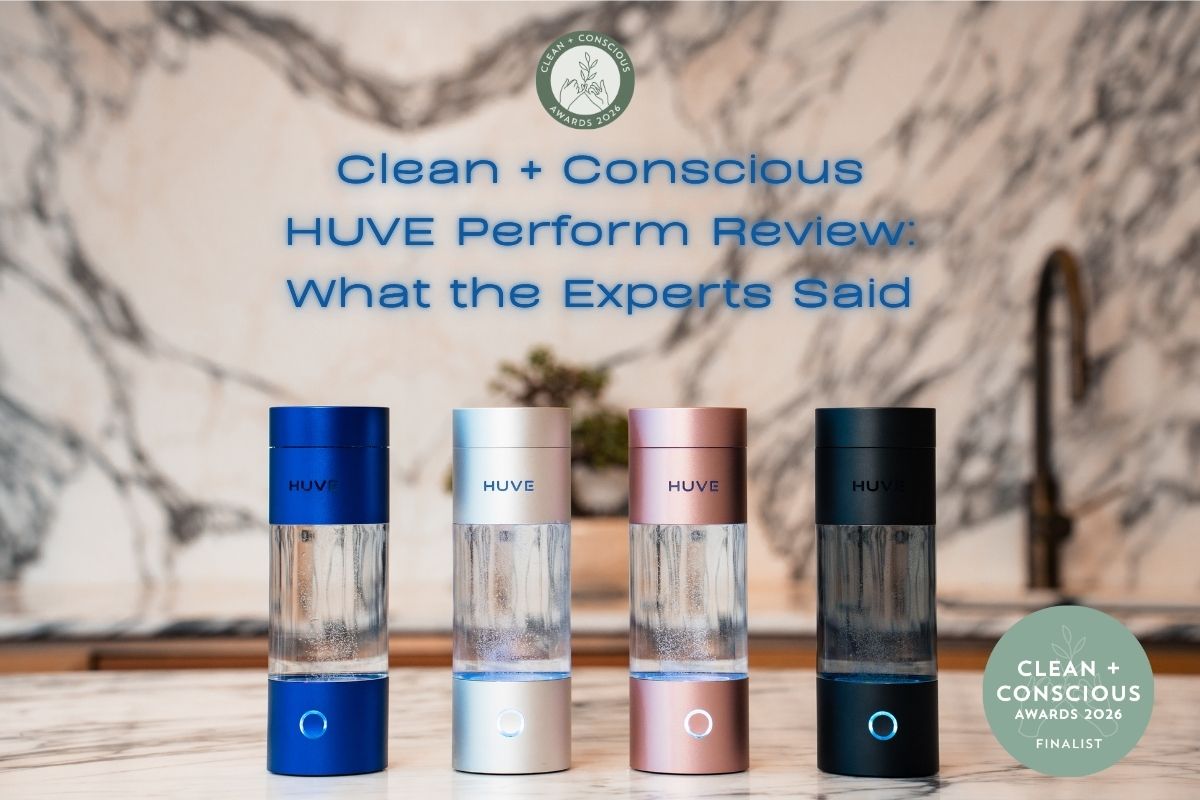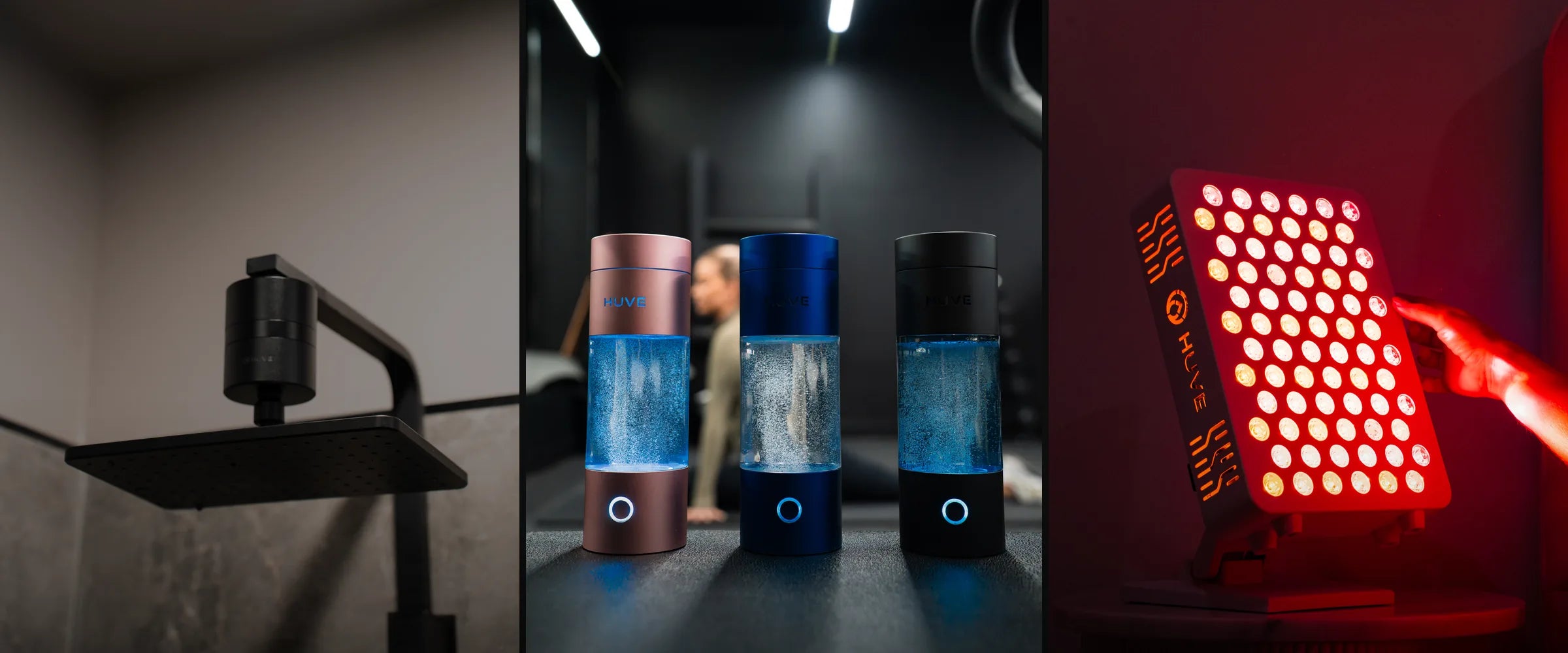
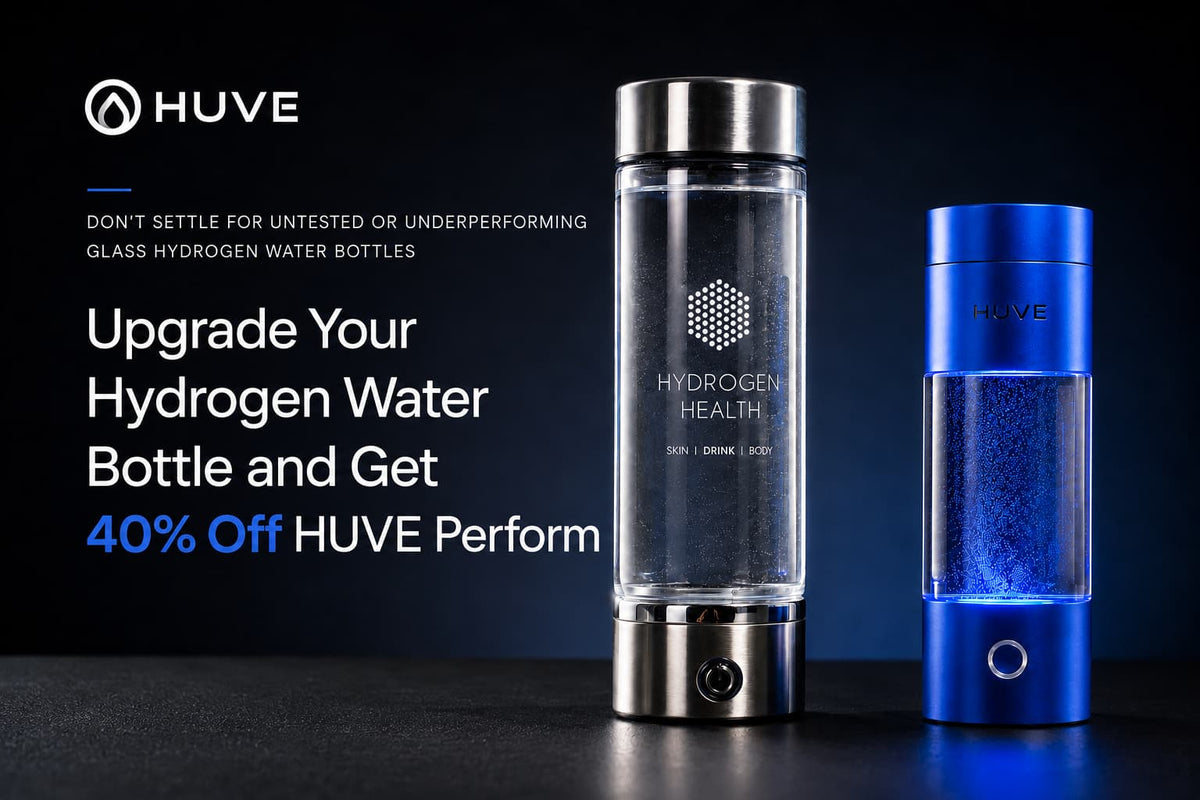
If you own a Hydrogen Health water bottle and want higher independently tested hydrogen performance in a smaller, more practical serving, HUVE is offering eligible customers a 40% voucher for the HUVE Perform Version 2.
The difference is not simply the number printed in parts per billion (ppb). What matters is the bottle's measured dissolved molecular hydrogen concentration, the total hydrogen dose in each serving, how quickly you can realistically drink that serving, the bottle material and whether the performance has been independently tested.
The Hydrogen Health Water Bottle is advertised as a 550 mL, semi-shock-resistant glass bottle producing up to 5,500+ ppb. In HUVE's testing of a Hydrogen Health bottle, the unit produced approximately 1,600 ppb—equivalent to a theoretical maximum of 0.88 mg of dissolved molecular hydrogen across 550 mL.
By comparison, independent H2HUBB testing measured the HUVE Perform Version 2 at an average 8.82 mg/L on its 10-minute cycle, with a peak of 9.3 mg/L. In a compact 230 mL serving, the measured average equates to approximately 2.03 mg of dissolved molecular hydrogen.
For people who want to consume their hydrogen water promptly after the cycle, that is a meaningful practical advantage: approximately 2 mg of H₂ in a volume that is realistic for most people to drink within a few minutes.
Hydrogen Health vs HUVE Perform Version 2: quick comparison
| Comparison | Hydrogen Health Water Bottle | HUVE Perform Version 2 |
|---|---|---|
| Bottle volume | 550 mL | 230 mL |
| Drinking chamber | Advertised as semi-shock-resistant glass | BPA/BPS-free Tritan™ with premium aluminium exterior components |
| Advertised or verified peak concentration | Advertised at up to 5,500+ ppb No 3rd Party Testing Published |
Independently measured peak of 9,300 ppb (9.3 mg/L) |
| Measured result used in this comparison | Approximately 1,600 ppb from the Hydrogen Health unit assessed by HUVE | H2HUBB average of 8,820 ppb and peak of 9,300 ppb on the 10-minute cycle |
| Theoretical H₂ dose based on measured result | Approximately 0.88 mg in 550 mL | Approximately 2.03 mg in 230 mL, based on the 8.82 mg/L average |
| Independent performance evidence linked for consumers | The product page reviewed on 21 August 2026 advertises up to 5,500+ ppb but does not link to an independent concentration certificate or identify the measurement method | Full H₂ Analytics and H2HUBB reports are linked from the HUVE product page |
| Everyday practicality | Larger volume can take longer to finish; glass requires more careful handling | Compact single serve, shatter-resistant material and easier to consume promptly |
Testing note: The approximately 1,600 ppb Hydrogen Health result relates to the specific unit assessed by HUVE and should not be interpreted as a measurement of every unit. Results can vary with the unit, source water, water temperature, fill level, cycle procedure, sampling and test method.
Concentration is not the same as dose
Hydrogen bottle marketing often focuses on concentration which is usually expressed as ppb, ppm or mg/L. However concentration alone does not tell you how much dissolved hydrogen is available in a serving.
For hydrogen water, 1,000 ppb is approximately equal to 1 ppm or 1 mg/L. The theoretical hydrogen dose is calculated as:
Hydrogen dose (mg) = concentration (mg/L) × volume (L)
Hydrogen Health: advertised claim versus the tested unit
If the advertised 5,500+ ppb concentration were present throughout the full 550 mL bottle when consumed, the theoretical dose would be:
5.5 mg/L × 0.55 L = 3.03 mg H₂
However, the Hydrogen Health bottle assessed by HUVE measured approximately 1,600 ppb, producing a different theoretical result:
1.6 mg/L × 0.55 L = 0.88 mg H₂
That 0.88 mg is the theoretical amount present at the time of measurement. To consume close to that amount, the user would need to drink the entire 550 mL promptly, before more hydrogen escapes from the water.
Realistically we understand that glass is not well suited to high pressure hydrogen bottle applications so the result was not surprising.
HUVE Perform Version 2: Independently measured concentration and dose
H2HUBB tested HUVE Perform Version 2 with 230 mL of water and recorded:
- 5-minute cycle average: 5.03 mg/L
- 10-minute cycle average: 8.82 mg/L
- Peak concentration: 9.3 mg/L, or 9,300 ppb
- Approximate dose from the 10-minute average: 2.03 mg H₂ in 230 mL
- No detectable chlorine or ozone in H2HUBB's safety testing
The dose calculation is:
8.82 mg/L × 0.23 L = 2.03 mg H₂
These results come from the independent H2HUBB review of HUVE Perform, not simply an unverified headline claim.
Why a smaller 230 mL hydrogen serving is an advantage
Molecular hydrogen is a very small gas molecule. Once a hydrogen cycle finishes and the bottle is opened, dissolved hydrogen begins escaping into the surrounding air. That is why hydrogen water is best consumed soon after it is generated.
A large bottle can appear better because it contains more water, but it can be less practical if the user needs a longer time to finish it. The relevant question is not, “How much water does the bottle hold?” It is:
How much dissolved molecular hydrogen can I realistically consume while it is still present?
HUVE Perform Version 2 concentrates approximately 2 mg of dissolved molecular hydrogen into 230 mL based on H2HUBB's measured average. For most people, 230 mL is far more realistic to drink promptly than 550 mL. This helps minimise the time available for hydrogen loss between opening the bottle and finishing the serving.
This does not guarantee that the body absorbs every milligram measured in the bottle. “Dose” in this comparison means the calculated amount of dissolved H₂ present in the tested volume at measurement. Individual absorption and biological responses can vary.
How HUVE Perform compares with the IHSA hydrogen standard
The International Hydrogen Standards Association (IHSA) distinguishes between concentration and total dose. Its current standards for hydrogen-water-generating devices state that a device should produce at least 0.5 mg of H₂ per litre serving and a minimum concentration of 0.5 mg/L. Its earlier concentration and dose guidance similarly explains a benchmark of at least 0.5 mg H₂ within a maximum of 1 L of product water.
The IHSA separately lists a higher requirement for specialty beverages: at least 1.0 mg in a serving of no more than 500 mL. That beverage category should not automatically be treated as the certification category for a hydrogen-generating bottle, but it is useful context when comparing practical serving doses.
Based on the measured results used in this article:
- The tested Hydrogen Health unit's theoretical 0.88 mg dose is above the IHSA's 0.5 mg device-dose benchmark—provided the full 550 mL is consumed while that hydrogen remains dissolved in the water.
- HUVE Perform Version 2's independently measured average provides approximately 2.03 mg in only 230 mL—more than four times the 0.5 mg IHSA benchmark in just 230ml.
Glass vs Tritan™ in a hydrogen water bottle
Glass has genuine advantages: it is transparent, chemically inert and visually premium. For an ordinary unpressurised drinking bottle, those qualities can make it an excellent material.
A hydrogen-generating bottle has different engineering demands. Electrolysis produces gas, and retaining more dissolved hydrogen generally involves controlling the pressure created during the cycle. Portable glass is rigid and brittle: it does not flex under impact and can crack or shatter if dropped, damaged, thermally shocked or exposed to pressure beyond the completed bottle's design rating.
That does not mean no engineered glass vessel can ever hold pressure. It means a portable consumer glass bottle cannot safely be assumed to tolerate the same operating conditions as a purpose-engineered, shatter-resistant polymer chamber. The safety and pressure capacity of any bottle depend on its complete design, manufacturing quality, seals, pressure-relief system and validation—not the material name alone.
HUVE selected BPA/BPS-free Tritan™ for Perform because it offers the clarity consumers like about glass while being lighter and substantially more impact resistant for everyday use. Eastman identifies Tritan grades for water and sports bottles and documents high impact resistance, toughness, hydrolytic stability and repeated-use food-contact suitability. You can read HUVE's full Tritan vs glass vs polycarbonate hydrogen bottle comparison and Eastman's Tritan TX2001 technical data.
For a product intended to generate hydrogen under pressure and travel between home, work, the gym and daily activities, Tritan offers a more practical balance of clarity, durability, low weight and impact resistance than glass.
As the founder of HUVE
As the founder of HUVE, my journey started as a Hydrogen Health customer.
I used the bottle because I wanted to experience the potential benefits of hydrogen-rich water, but I personally felt no noticeable benefits. A personal experience cannot prove whether a product will or will not benefit somebody else, but it prompted me to investigate what the bottle was actually producing.
When the Hydrogen Health bottle I assessed measured at approximately 1,600 ppb, well below its advertised claim of up to 5,500+ ppb, I started looking more closely at concentration, serving volume, dose, pressure, materials and independent testing.
That investigation ultimately led me to found HUVE and create the original HUVE Perform. My goal was straightforward: develop a compact, durable hydrogen water bottle that could deliver a dose comfortably above the IHSA's published 0.5 mg benchmark and prove its performance through third-party testing.
The original HUVE Perform achieved independently measured concentrations of approximately 5.12 to 5.60 mg/L in a 230 mL serving—equal to roughly 1.18 to 1.29 mg of dissolved H₂ per serve. HUVE Perform Version 2 has raised that to an independently measured average of approximately 2.03 mg per 230 mL serve, with a peak concentration of 9.3 mg/L.
For me, that is the difference between buying a hydrogen water bottle based on a claim and choosing one based on measurable, independently tested performance. It is also a level of verified performance that the glass Hydrogen Health bottle I tested did not match.
— Josh Odgers, Founder of HUVE
Why independent hydrogen testing matters
Visible bubbles, a negative ORP reading and a large concentration claim do not prove how much dissolved molecular hydrogen is in the water. A meaningful comparison should identify:
- The measurement method
- The cycle length and fill volume
- The average result—not only the highest reading
- The total calculated dose per serving
- Whether unwanted electrolysis by-products were assessed
- Whether the test was performed by an independent specialist
HUVE publishes its independent performance evidence so customers can review the data behind the claims. The HUVE Perform product page links both the full H₂ Analytics report and the H2HUBB report.
How to upgrade from Hydrogen Health to HUVE and receive 40% off
If your Hydrogen Health bottle no longer meets your expectations, you may be eligible to receive a 40% voucher for HUVE Perform Version 2.
To claim the offer:
- Create and post a short social media video showing yourself responsibly recycling or disposing of your current bottle.
- In the video, say: “I'm upgrading to the HUVE Perform.”
- Tag @HUVE_official.
- Include #HUVE #UpgradeToHUVE #WellnessElevated.
- HUVE will contact qualifying participants by direct message with a 40% voucher.
You can also email support@huve.com.au to request the voucher. Promotion eligibility and terms apply. Read the full HUVE hydrogen water bottle upgrade offer before participating.
Please dispose of the old bottle responsibly. Because hydrogen water bottles contain a rechargeable battery and electronic components, use an approved battery or e-waste recycling facility and follow your local recycling requirements. Do not place the electronic base in general household waste.
Frequently asked questions
Can I upgrade my Hydrogen Health bottle to HUVE Perform Version 2?
Yes. A Hydrogen Health bottle can qualify for HUVE's upgrade promotion, subject to the offer's eligibility requirements and terms. Follow the recycling-video instructions or email support@huve.com.au to request your 40% voucher.
How do I get 40% off HUVE Perform Version 2?
Post a short video showing the responsible recycling or disposal of your Hydrogen Health bottle, say “I'm upgrading to the HUVE Perform,” tag @HUVE_official and include #HUVE, #UpgradeToHUVE and #WellnessElevated. HUVE will send qualifying participants a voucher by DM. You can also contact support@huve.com.au.
What is the main difference between Hydrogen Health and HUVE Perform Version 2?
The main differences are measured hydrogen performance, serving size, construction and published independent 3rd party testing. The Hydrogen Health product page advertises up to 5,500+ ppb in 550 mL however this claim is not backed with transparent 3rd party testing. H2HUBB independently measured HUVE Perform Version 2 at an 8,820 ppb average and 9,300 ppb peak, delivering approximately 2.03 mg H₂ in 230 mL.
Does the Hydrogen Health bottle really produce 5,500 ppb?
Hydrogen Health advertises “up to 5,500+ ppb” but provides no independent 3rd party testing supporting this claim. Consumers should ask for an independent report identifying the test method, cycle, water conditions and repeat results.
How much hydrogen does HUVE Perform Version 2 deliver?
H2HUBB measured an average concentration of 8.82 mg/L on the 10-minute cycle. Across the tested 230 mL serving, this equals approximately 2.03 mg of dissolved molecular hydrogen. The peak measured concentration was 9.3 mg/L.
Why should hydrogen water be consumed quickly?
Dissolved molecular hydrogen begins escaping once the water is exposed to air. Drinking hydrogen water soon after the generation cycle helps reduce the amount lost before consumption. Keep the bottle closed until you are ready to drink, open it carefully and consume the serving promptly.
Is a 230 mL hydrogen water bottle too small?
Not when it is designed around dose rather than ordinary hydration volume. HUVE Perform Version 2 delivers approximately 2.03 mg of H₂ in a compact 230 mL serving based on H2HUBB's measured average. You can continue drinking ordinary water separately for your broader hydration needs.
Is Tritan™ better than glass for a hydrogen water bottle?
For a portable hydrogen-generating bottle, Tritan can provide a more practical combination of clarity, low weight, impact resistance and design flexibility. Glass is chemically inert but is heavier and brittle. The safety of either material still depends on the complete bottle design, manufacturing quality, operating pressure and validation.
Is HUVE Perform Version 2 independently tested?
Yes. HUVE publishes third-party testing from H₂ Analytics and H2HUBB. H2HUBB measured an 8.82 mg/L average, 9.3 mg/L peak and approximately 2.03 mg H₂ per 230 mL serving on the 10-minute cycle. It also reported no detectable chlorine or ozone in its safety testing.
Does a higher hydrogen dose guarantee better health results?
No. A higher measured dose means more dissolved molecular hydrogen is available in the serving at the time of measurement, but it does not guarantee a particular health outcome. Research into hydrogen-rich water is continuing, and individual responses may vary. Hydrogen water is not a substitute for medical care or prescribed treatment.
Upgrade to independently tested hydrogen performance
If you purchased a Hydrogen Health bottle but now want a smaller, more durable and independently tested alternative, HUVE Perform Version 2 was built for exactly that purpose.
With an independently measured average of approximately 2.03 mg of dissolved molecular hydrogen in just 230 mL, BPA/BPS-free Tritan™ construction and a 10-minute high-concentration cycle, HUVE Perform Version 2 makes it practical to generate, open and consume a high-dose hydrogen serving promptly.
Claim your 40% HUVE Perform Version 2 upgrade voucher
Information and product claims were reviewed on 21 August 2026. Product results can vary with the unit, water, temperature, fill level, cycle and test method. This article is general information and is not medical advice.