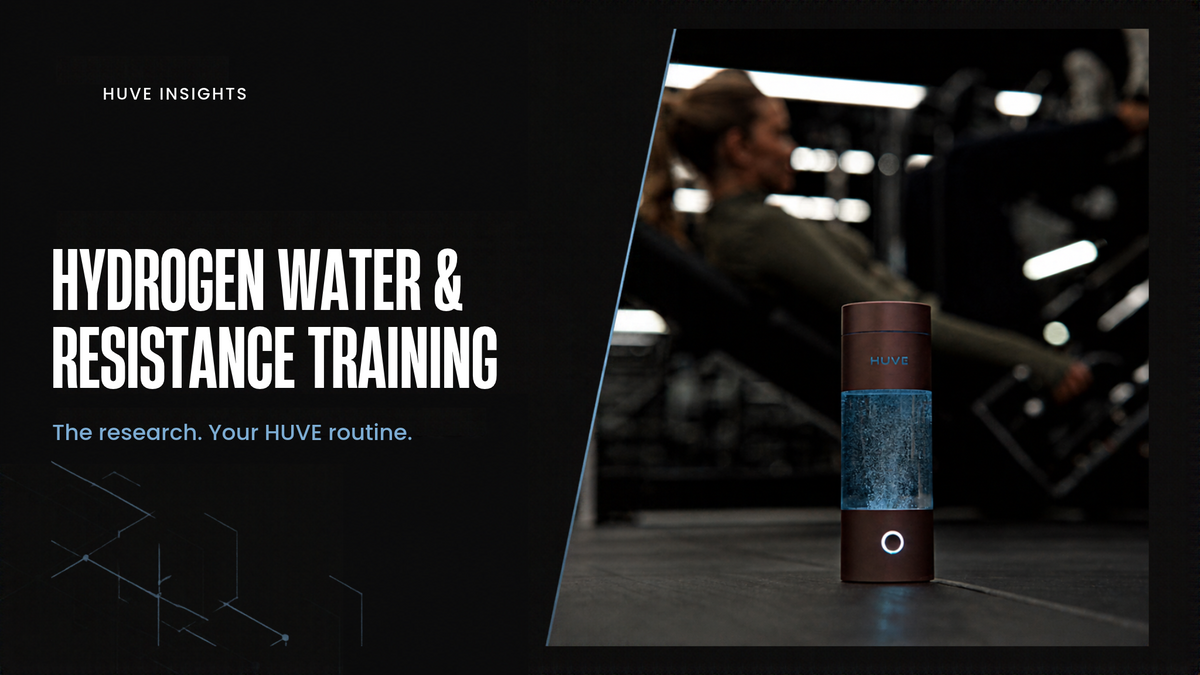
Hydrogen water research is producing encouraging findings for resistance training. HUVE Perform’s higher hydrogen concentration makes it possible to consume comparable hydrogen amounts in smaller servings—and with Perform V2, a convenient five-minute cycle.
A 2024 randomised, double-blind crossover study involved 18 trained young men. After eight days of hydrogen-rich water, participants performed six sets of half-squats to failure at 70% of their one-repetition maximum. Compared with plain water, they achieved:
- 11.2% more total repetitions: 78.2 versus 70.3.
- 9.6% higher reported total power output.
- No statistically significant improvement in jump recovery, muscle soreness or perceived recovery.
Both performance differences were statistically significant. These findings are promising, although a small, short study cannot guarantee individual results. Read the study in Frontiers in Physiology.
Understanding concentration and dose makes the comparison useful. Concentration tells you how much dissolved hydrogen is present per litre. Dose tells you how much hydrogen is contained in the serving you drink.
Hydrogen amount (mg) = concentration (mg/L) × serving volume (litres).
A smaller, more concentrated serving can therefore contain more hydrogen than a larger glass of water.
| Water or bottle | Cycle | Hydrogen concentration | Serving volume | Hydrogen per serving |
|---|---|---|---|---|
| Study water | Not specified | 1.60 mg/L | 320 mL* | 0.51 mg |
| HUVE Perform V1 | 5 minutes | 3.10 mg/L average | 230 mL | 0.71 mg |
| HUVE Perform V1 | 10 minutes | 5.60 mg/L average | 230 mL | 1.29 mg |
| HUVE Perform V2 | 5 minutes | 5.03 mg/L average | 230 mL | 1.16 mg |
| HUVE Perform V2 | 10 minutes | 8.82 mg/L average | 230 mL | 2.03 mg |
*The study’s six daily servings totalled 1,920 mL, implying 320 mL each. Its concentration was manufacturer-specified. HUVE values use reported laboratory averages, rather than peak readings, from the V1 H₂HUBB report and V2 H₂HUBB report. Hydrogen amounts are calculated before rounding.
Perform V2 delivers a substantial hydrogen amount in just five minutes. Its tested five-minute average is approximately 3.1 times the study’s stated concentration, providing more than twice the hydrogen in the study’s implied serving.
The ten-minute cycle increases those comparisons to approximately 5.5 times the concentration and four times the hydrogen per serving. These are comparisons between published figures, rather than results from a controlled comparison between bottles.
The original study used repeated, freshly prepared servings. Participants consumed 1,920 mL daily for seven days. On training day, they drank 210 mL at 30 minutes before, one minute before, midway through and immediately after exercise, followed by 420 mL after another 30 minutes.
Calculated totals were 3.07 mg of hydrogen per day during the first seven days and 2.02 mg across the training-day servings. Study protocol.
A simple HUVE adaptation uses three whole bottles per day. Because HUVE Perform produces significantly higher hydrogen concentrations than those reported in the study, fewer servings can exceed its calculated daily hydrogen amount.
For the seven days before your planned training session:
| Your bottle | Simple daily routine | Daily water volume | Estimated hydrogen |
|---|---|---|---|
| Perform V1 | Three full bottles using 10-minute mode | 690 mL | 3.86 mg |
| Perform V2 | Three full bottles using 5-minute mode | 690 mL | 3.47 mg |
Space the servings across your day—for example, morning, lunchtime and evening.
For Perform V2, five-minute mode is sufficient to exceed the study’s calculated daily hydrogen amount with three servings. That means five minutes of preparation per serving, or 15 minutes across the day.
V1 owners can also use five-minute mode, but would need five full servings to exceed that daily amount, providing approximately 3.57 mg. Three ten-minute servings offer a simpler routine with fewer refills.
These are estimated hydrogen amounts based on laboratory averages. Matching or exceeding an amount does not establish the same training benefit.
On training day, place your three servings around your session.
| Timing | Perform V1 | Perform V2 |
|---|---|---|
| Around 30 minutes before training | One bottle, 10-minute cycle | One bottle, 5-minute cycle |
| During a suitable break midway through training | One bottle, 10-minute cycle | One bottle, 5-minute cycle |
| After training | One bottle, 10-minute cycle | One bottle, 5-minute cycle |
This whole-bottle routine is an adaptation inspired by the research. It changes the original serving frequency, water volume and hydrogen amount. Neither HUVE model nor this adapted schedule was tested in the trial, and higher hydrogen intake has not been shown by this study to produce greater benefits.
Prepare each serving fresh.
- Fill your HUVE Perform with 230 mL of filtered or purified drinking water, following its instructions.
- Secure the lid and select the appropriate cycle.
- Drink promptly once the cycle finishes.
- Prepare a fresh bottle for your next serving.
For the pre-training serving, start V1’s ten-minute cycle about 40 minutes before exercise, or V2’s five-minute cycle about 35 minutes before. Both will be ready around 30 minutes before you begin. Allow preparation time for the later servings, too. HUVE Perform product information.
Continue your usual hydration throughout the day and around exercise; the volumes above cover only the hydrogen-water servings. Actual hydrogen intake can vary with preparation and the time between generation and drinking.