Red and near-infrared light therapy is opening an interesting new area of fertility research. Scientists are investigating whether carefully selected wavelengths can support the cellular processes involved in reproduction—and early findings give them reasons to keep exploring.
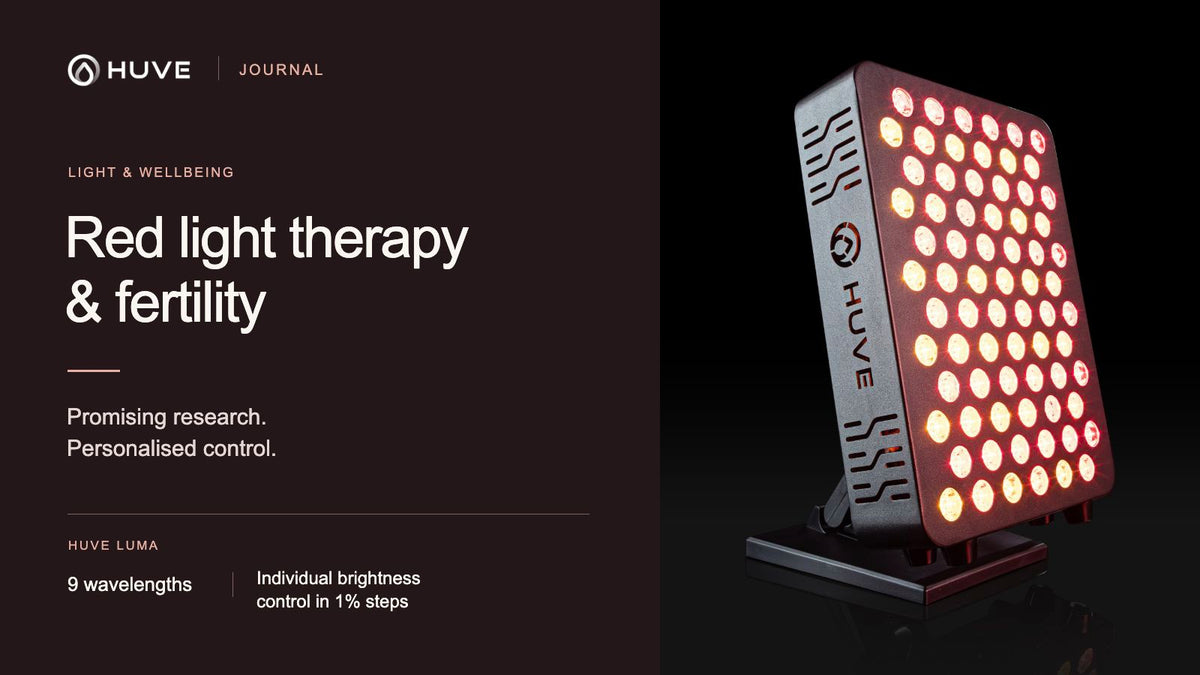
For women considering light therapy alongside fertility care, the opportunity starts with understanding the research and discussing it with their treating physician. HUVE LUMA adds a practical feature to that conversation: individual control over nine wavelengths, with brightness adjustable separately in 1% increments.
Promising findings are emerging
A 2026 study explored 630 nm red LED light in women with diminished ovarian reserve. Among 10 participants, median antral follicle count—the number of small follicles visible on ultrasound—increased from two to six, a statistically significant change (p=0.011).
That is an encouraging finding worthy of further investigation. However, the increase in eggs retrieved was not statistically significant, and the small exploratory study did not establish an improvement in pregnancy rates. Read Su et al., 2026.
Earlier research also documented pregnancies following near-infrared treatment. A Japanese programme using 830 nm light reported 156 pregnancies and 79 live deliveries among 701 women with severe infertility. These outcomes helped motivate interest in photobiomodulation, although the absence of an untreated comparison group—and the use of other fertility treatments—means researchers could not determine how much light therapy contributed. Read Ohshiro, 2012.
One 2024 pilot study reported a statistically significant difference in clinical pregnancy rates: 46.15% with laser treatment versus 26% in the comparison group (p=0.034). The treatment used an 880 nm laser delivered inside the uterus, making it a specialist procedure that an external panel cannot reproduce. The study also had reporting inconsistencies and differences between the groups that limit confidence in the result. Read Hoseinzade et al., 2024.
The evidence is not uniformly positive. A separate randomised trial involving 30 women tested 850 nm laser treatment before embryo transfer. Clinical pregnancy rates were numerically higher—33.3% versus 20%—but the difference was not statistically significant (p=0.682). This leaves the question open rather than demonstrating a benefit. Read Jafarabadi et al., 2024.
Together, these studies offer useful directions for further research. They do not yet establish that a home light therapy panel improves pregnancy or live-birth rates, and none of these studies tested HUVE LUMA.
HUVE LUMA puts wavelength selection in your hands
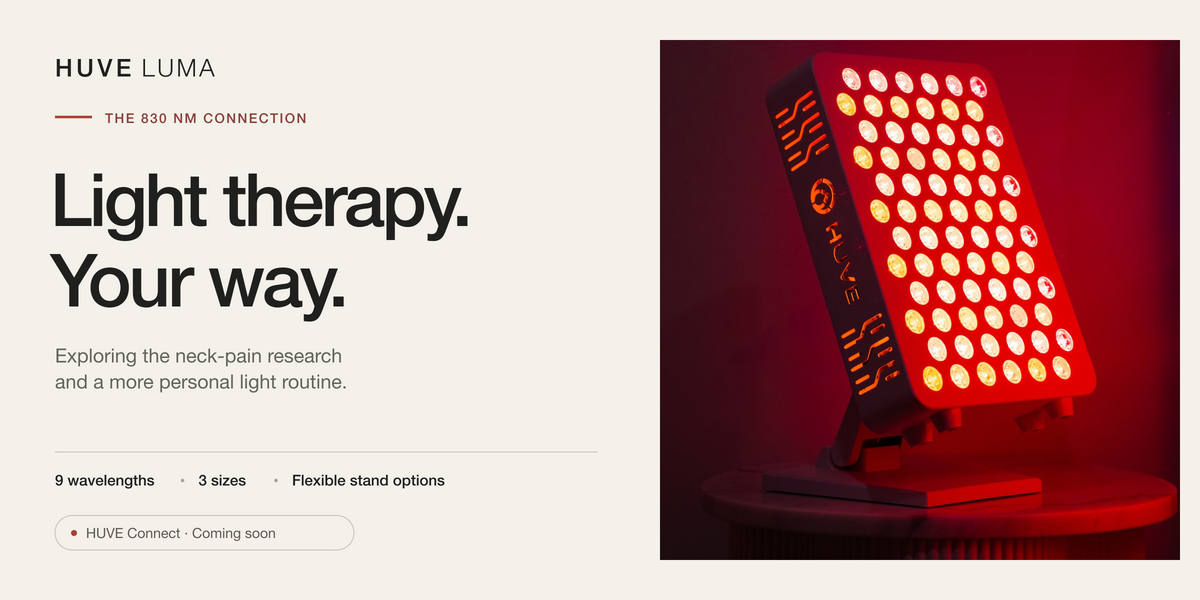
HUVE LUMA includes 480, 590, 630, 660, 670, 810, 830, 850 and 1060 nm. Its range therefore includes the 630, 830 and 850 nm wavelengths investigated in the studies above. It does not include the 880 nm wavelength used in the intrauterine pilot. View HUVE LUMA’s specifications.
Its customisation goes beyond choosing a general red or near-infrared mode:
- Select any combination of the nine available wavelengths.
- Adjust each wavelength’s brightness independently in 1% increments.
- Leave unselected wavelengths off, allowing a focused configuration.
For example, LUMA allows 630 nm to be selected on its own, or available red and near-infrared wavelengths to be combined with separately adjusted brightness. These are examples of device capabilities, not recommended fertility protocols.
That flexibility can be useful when discussing a proposed approach with your treating physician. If they consider external light therapy appropriate, they can assess whether LUMA’s available wavelengths and settings suit their guidance.
Individual control supports a more considered approach
Matching a study requires more than selecting the same wavelength. Researchers also specify the light output, exposure time, treatment area, application method and session schedule. These details matter when assessing whether two treatments are comparable. Read the photobiomodulation reporting guidance.
LUMA’s 1% brightness adjustments provide fine control over its settings, but a brightness percentage is not a measured treatment dose. Confirming an appropriate exposure requires output information for the selected settings and distance. Sharing a wavelength with a research device does not establish equivalent treatment or results.
For women interested in this emerging field, LUMA offers a clear practical strength: the freedom to select individual wavelengths and adjust their brightness to support a physician-approved configuration within the device’s capabilities.
Discuss whether light therapy belongs in your care, how it would fit around fertility treatment, and when to pause or reassess its use—including after embryo transfer or a positive pregnancy test.
Explore the possibilities with HUVE LUMA
Discover all nine wavelengths and individual brightness controls, then share the specifications with your fertility specialist to discuss whether LUMA is suitable for their guidance.
Explore HUVE LUMAThis article is educational and does not provide a fertility treatment protocol. Follow your treating physician’s advice and the HUVE LUMA user guide.